8.07.2007

Solving a better problem

I recently bought gift cards for a project at work. I don't typically buy gift cards, so it had been a while. But in case you too prefer more tangible presents, let me send you a transmission from the world of gift cards: Things are getting crazy over here!

First, a brief summary of why people DO buy gift cards. They don't know the person that well. They don't feel confident in their ability to find the right gift. They imagine the recipient would prefer to do their own shopping. They have a very set budget. Gift cards are convenient and "you can't go wrong."

Next, a brief summary of why people DON'T buy gift cards. They are impersonal. They ask the recipient to do the work of shopping. They are the equivalent of handing someone cash. They say exactly how much you spent. They seem generic and trivial. They are "a cop-out."

Regardless, sales of gift cards are rising each year, and so I have to imagine shoppers are weighing the pros favorably against the cons. But some of those cons are still keeping shoppers like me away, so I think there's room for improvement.

But hold the phone. I said improvement, not meaningless, over-the-top embellishment. Folks, the gift cards I purchased were from Woodfield Mall, an upscale shopping center in the Chicago suburbs. Each card came with six (6) items.
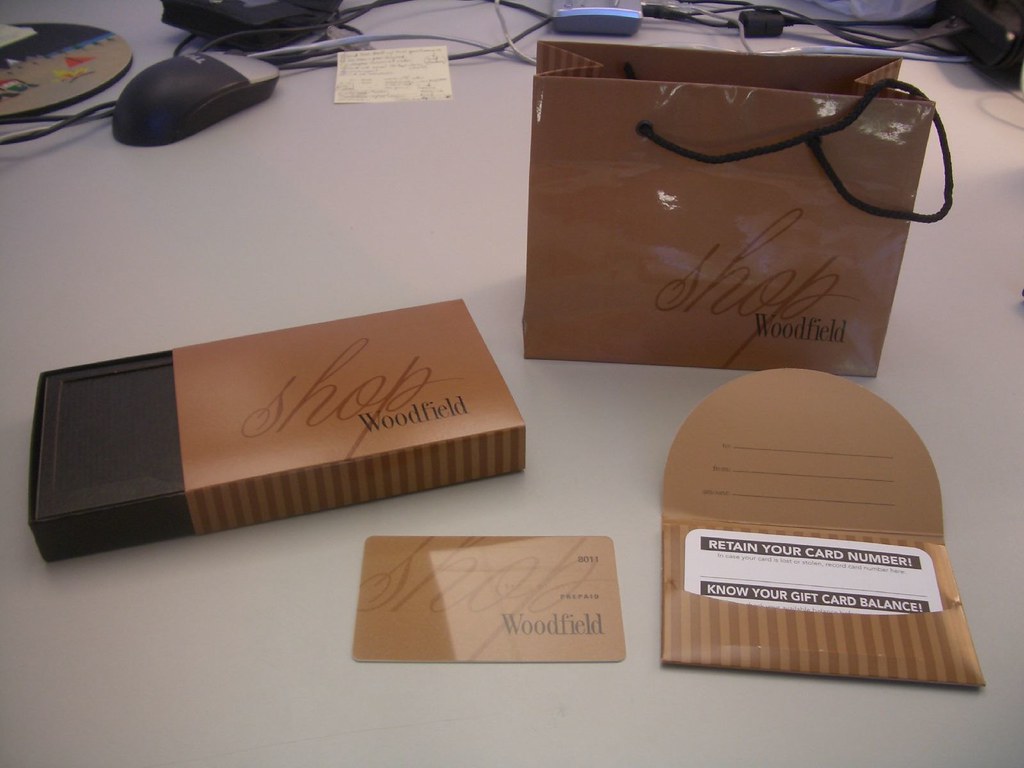

You've got your card, you've got your note, you've got your envelope, you've got your box, your sleeve, and your bag. Card goes in envelope with note, envelope goes in box, box slides into sleeve, and sleeve drops into bag. Can we say, overpackaged?

Now, I think I know what the designers of the Woodfield Mall gift card extravaganza were thinking. They probably had research which said, "30% of our shoppers agree that gift cards are not an adequate gift." So they did the first thing that came to mind: they dressed it up. Made it fancier. Now it looks more like jewelry, or chocolates. There are at least three moments of surprise in this experience - opening the bag, opening the box, and opening the envelope. I'd even venture to guess that when someone finally gets to the card inside, they're a bit let down. "What's this? Ooh, what's this? Ooooh, now what's this? Oh, a gift card."

But even if that recipient is pleased as punch to get a gift card to a mall, I'm not sure this redesign has made anyone a born-again gift card believer. Because I feel they have solved the wrong problem.

They went from a generic problem (gift cards aren't good enough) to a generic solution (let's make them seem better). But let's try digging a little deeper, shall we? Why aren't they good enough?

1. Because they are impersonal. There is nothing about the gift card, save your choice of store, that personalizes the present. He's a sports nut? Let's get him a gift card to Foot Locker! But that was your only real "decision," and it's not exactly "thoughtful."

So, what are ways of making gift cards more personal? The store could print your name and a note right onto the card. How about a note in your handwriting? How about your picture on the card? Better yet, what if you could bring in an old photo of you and the recipient, and the store could screen the photo onto the back of the card? Now that card is a keepsake for his wallet!

Or maybe the store offers gift cards in ten designs, so you can pick the style he'll like best. Maybe you could design your own card? Choose pictures of items he might want, to suggest what he could buy with the card? And once he's chosen the gift, how about a personal follow-up? Maybe the card allows him to enter a photo booth in the store, take a picture of himself with the item, and send it to you?

The point is, surely stores can dream up ways of making the card reflect the giver, the recipient, or both.

2. Because they are trivial. It's just a piece of plastic, after all, and once he cashes it in, the experience is over. Sure, now he has an actual gift, but what role did the card play? It sat in his wallet. It's nothing more than a representation of money. Meh.

So, what are ways of making gift cards meaningful? Useful beyond their primary function? Able to be priced at higher than their dollar value? Well, maybe the gift card isn't a card. Maybe it's a vase. The person receives the vase, brings it to the flower shop, and gets a free bouquet. Or the gift card is a picture frame. She brings it to Sears Portrait Studio for a free session.

Furthermore, if you boil down the function of a gift card, its purpose is to represent a gift until someone actually gets it. Maybe the gift card is a wrapped, empty box? A shopping bag, which you bring to the store and fill? A scanner, which you use to zap the item that you want, a la wedding registries? Stores should think about how to make that gift card work a little harder, so that it creates value beyond its cash equivalent.

3. Because the money thing is awkward. This one is tough. You don't necessarily want the person to know right away how much you've spent on them, yet you want them to receive that amount in the store.

So, what are some ways of making gift card values less awkward? Well, maybe we could make the dollar amount less hush-hush. More explicit and interesting. I know that in Jewish tradition, checks are often written in multiples of 18, which is considered lucky. For a wedding, you might give a check for $72. Maybe we could make the dollar amounts totally flexible, to reflect something similarly cultural.

Or perhaps the money could reflect the occasion? My birthday is January 10th. I'd sure love a gift card for $110. Or even just $10, where the card had a little calendar with January 10th circled. Birthday gift cards. Stores could also keep the dollar amount hidden, until you get to the store and find out what you've got. Now you have to come in! Ooh, what if it was a lottery? All gift cards cost $20, and yours has a value of at least $20, but it might be a lucky $100 winner!

---

Retailers love gift cards for various reasons. Pay us now, take the merchandise later; try our store for the first time; chances are you'll spend more than the value of the card. So if it's important enough, retailers should be looking for ways to optimize this product.

My point is that there are plenty of ideas to be found, when you think about the problem in a more specific, user-centered way. Instead of saying gift cards should look nicer, get to more tangible goals. In this case, gift cards should be more personal, more meaningful and less awkward. These are quite simply more interesting problems to solve.

However, dear shopper, at the end of the day, you're still giving someone the equivalent of cash. My final suggestion: why don't you try picking out an actual gift?

7.16.2007

Self-checkout for dummies

Oh, the self-checkout. That glorious innovation of the retail world. The unbridled freedom it brings to the quick-trip shopper. The confidence it inspires in its self-empowered users.

The Lord of the Flies is what it really is. There's a long line and no authority and suddenly, everybody wants to kill someone. I'd love to jump up and take control: You - over there! What's your problem? Get your debit card facing the right way! Load your groceries! There's an unexpected item in the bagging area! Get to it, man!

In reality, though, we all just kinda stand there, annoyed. The rules aren't posted, aren't enforced, and aren't even clear in the first place.


A few weeks ago, on the third of July, my local Jewel was hopping with youngsters buying beer and snacks for the holiday. Each person had been planning to run in, buy four things, and run out. But the line for the self-checkout was at least twelve people long.

Fortunately, the store's not stupid. They anticipated the rush. What did they do?

They brought in This Guy.


This guy might be the store owner, or some unfortunate soul from corporate. But thank god for him, because he enforced the rules. Rules that I forgot existed! I delighted in watching him stop people who were trying to cut the line, and helping shoppers who couldn't figure out why the machine was so mad at them.

It got me thinking. This guy is fabulous. He's making order from chaos. But he's not going to be here tomorrow. And the problems still are. The self-checkout may be helping the store process customers and save money, but it's got plenty of issues. And I believe these issues stem from a lack of clarity on the rules.


So in an effort to help you, me and everyone we know, here are my 5 rules of the self-checkout.

1. There Is A Line. How many times are you waiting in line, and some guy walks right up to a machine? Just cuts in front of all the patient folks? Buddy, there are no frontsies, no backsies, no cuts. There is a line, and it's your duty to find it. Oh, and there isn't a different line for each machine, either - there is one line for all of them. So wait your turn.

2. Pay Attention. How many times does some woman get to the front, receive a cellphone call, and totally tune out? When you are in line, and especially when you're first, you need to be scanning like a hawk. I want to see eagle eyes. When twelve angry shoppers are behind you, do not take your eye off the ball. For god's sake, do not answer your cellphone. Give the process some respect.
3. That Machine's Not Broken. This is classic crowd behavior. Nobody's using that machine, so it must be broken. Nobody continues to use that machine. It's like in the bathroom stalls, when nobody checks for feet - they just assume that one is unavailable because the door is closed. Why don't you try the machine, then tell us if it's broken? Don't worry, we won't let you lose your place in line.

4. Ten Items Or Less. Seriously. Don't bring your cart with a hundred dollars worth of kitty litter and tuna fish and expect to do the whole thing yourself. This line may move faster because there are 8 kiosks, but you are six hundred times slower than the lady at the register. If you need all that stuff, let the cashier do it. She is faster because unlike you, she is being paid for this.

5. The Bar Code Is Somewhere Else. Some people just cannot get a grip on the mechanism of the self-checkout. They're scanning and scanning, trying to get it to pick up their pineapple. Okay. Your pineapple has one sticker on its entire body. It's on the top. Stop scanning the bottom! Turn it! Flip it! Try something new! And people, you know who you are.

Now, I am making these rules up based simply on my own experiences. These rules were never shared, with me or anyone else. There was no training. No pamphlet. No Self-Checkout For Dummies. I mean, cashiers know what they're supposed to do. If their register freezes, they don't just stand there gazing into space. They get on the horn and fix it.

But shoppers are not cashiers. And as much as the store would love us to behave like free labor, we aren't going to do that because we don't know how. So stores, if you want your shoppers to behave like employees, then train us like employees, and post the rules. Your rules. Just tell us what you want us to do. We could use a little direction.

7.05.2007

How does my butt look?

This will be a shorter post, as I'm a busy girl with people to see and things to do.

---

Okay, we all know that's not true! Ha ha! Ha...But I am hereby starting a conscious effort to write some shorter posts, so that we don't go for weeks with none.

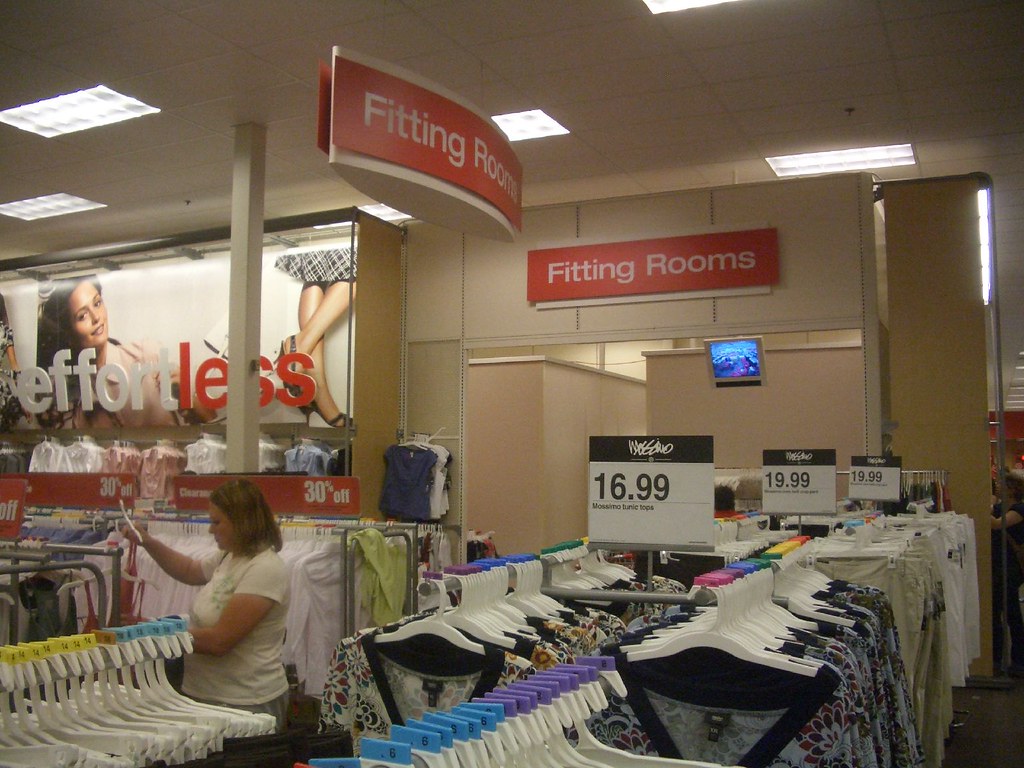
Today I'd like to talk about Target. Yes, they are the gold standard for mass retail; yes, they go where no discounter has gone before; and yes, they are captivating the crowds with their cheap chic offering and uncluttered merchandising and helpful in-store messaging and, you get the point. Target does a lot of things right.

But I want to mention one more thing that they have knocked out of the park. It's a design change that could have only come from the shopper's own voice. It's a very easy tactic that provides surprise and delight, improves the shopping experience and, I'm guessing, helps the bottom line at the end of the day.

So, most clothing stores have dressing rooms. These stores give up valuable retail space because people want to try things on. But in my recent interviews with female shoppers, I'm starting to notice a pattern: women don't like dressing rooms. Either they are too busy to try it on now, or they feel uncomfortable in such a small, messy, poorly-lit, barely-private space. So they buy, they take home, they try on, and THEN they make their final purchase decision.

As you can imagine, stores hate this. Returns? Annoying! We could have been selling that shirt to someone else while it was sitting in your bedroom! Plus, why did we spend 300 square feet on dressing rooms if you're not going to use them?


Well, Target sells clothes. Target has dressing rooms. And Target wants its dressing rooms to get used. So I'm guessing it took a good hard look at the trying-it-on experience, and resolved to provide something that you couldn't get at home.

I don't know about you, but my home has it pretty good. A full-length mirror in my bedroom, a brightly-lit mirror in my bathroom, and my boyfriend to give me his honest opinion. But my home does not have one thing. Friends, my home lacks a butt mirror.

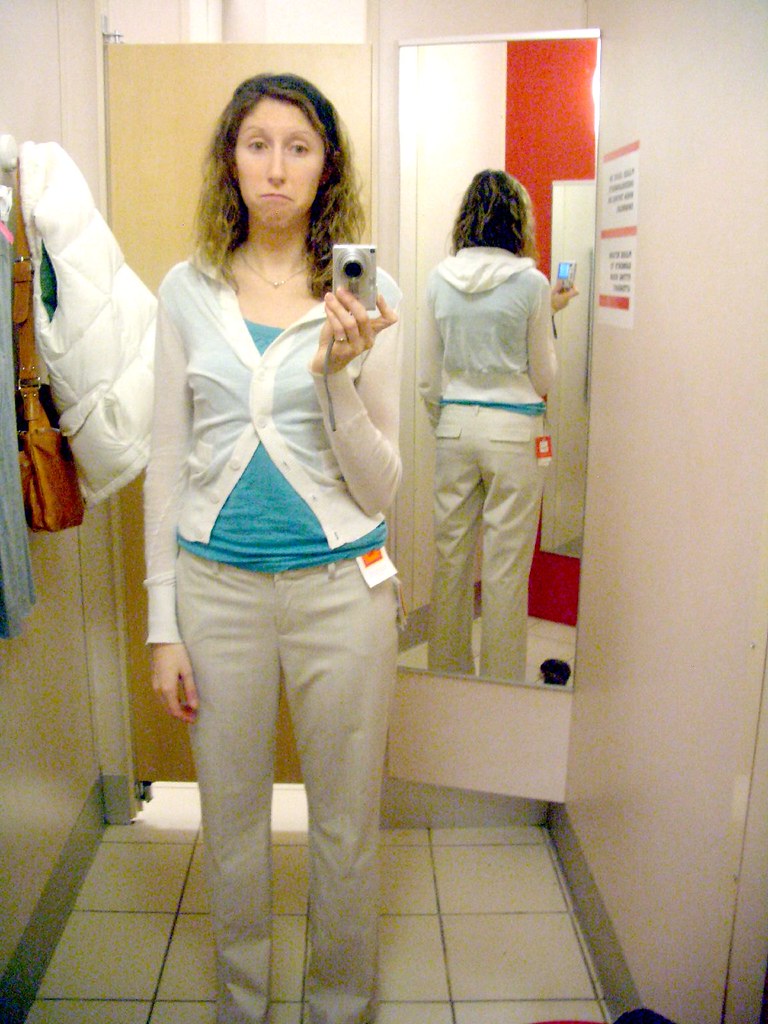
Target dressing rooms, on the other hand, have this mirror. It's surprisingly, refreshingly awesome. No more planting your hips squarely forward while you twist your neck around, catching a glimpse for three painful seconds. No more listening to a salesperson's pandering flattery. No more worrying about the question that has plagued women since the dawn of pants: How does my butt look in these?

I just bought pants at Target, and let me tell you, the butt mirror sealed the deal. It's at just the right angle to allow for a full viewing, like I was standing behind myself and checking myself out. And although I was undecided on the front of the pants, the back of the pants looked, in my opinion, well, okay. I thought it looked good.

Target, I'd rather try on clothes in your store than bring them home. Your dressing rooms are certainly no palace. But they have what no average residence contains. That infinitely wise, truth-bearing, all-knowing and all-illuminating butt mirror.

6.24.2007

The A-hole and the Prius

Just last week, an a-hole cut me off.


You see Officer, I was driving down Milwaukee Ave, which would be wide enough for two lanes if it weren't for the meters. Well, there's this cheeky move where you sneak up the "right lane," squeezing between the real traffic and the parked cars. When the light turns green, you step on the gas, cutting the whole line. While I will admit to pulling this move on rare occasions, I try to keep my road aggression to a minimum. I do believe in driving karma.

But apparently, this guy did not. He passed everyone, rolled up next to me, started moving before the light even changed, and boom - off he went.

Why did this surprise me? Because this a-hole was driving a Prius.

---

Eco-friendly products are the hottest ticket in town. They are showing up in every possible store, and every conceivable industry. Companies are creating new business models left and right based on our newfound desire to curb global warming.


And these days, there's an eco motivator for everyone. That woman might be buying organic milk because she wants the cows who produced her beverage to eat grass in a happy field. Or because she doesn't want her kids drinking bovine growth hormone with their cereal. Or maybe, just maybe she lives in a nice part of town, makes decent money, and knows that shoppers around her will note her organic choice. Come on, you know you look at what other people put down at the checkout.

But now, there is an even more compelling reason to go green. Eco-conscious products are finally paying off for consumers like us. Those compact fluorescent lightbulbs might be a couple bucks more at Wal*Mart, but my god, will you save on your electric bill. It's called ROI, baby, and it's convincing even the stingiest cynics to start reducing, reusing and recycling.

Now here's the thing. Lots of people have been making eco-conscious choices for a looong time. These people are the "true believers." They are kind, giving and selfless. They have been inconveniencing themselves for years by recycling, wearing organic cotton, composting their trash and carrying lunchboxes. These folks don't get refunds for bringing their own canvas shopping bags. They don't get tax breaks for biking to work. In their hearts, you will find only generosity. They are doing it for the children, the planet, the future of mankind.

But suddenly, a ton of newcomers have jumped on the LOHAS bandwagon. And you might say some of the true believers are, well, quietly ticked. It's kind of like when your favorite indy band gets on the radio. It's equal parts "this is mine, don't take it away from me" and "I told you so."

And sure, the new eco buzz is not all genuine. Greenwashing is everywhere and lots of companies are focusing on the perception factor, rather than the real deal. Debates run rampant as to whether hybrid cars are actually better for the environment, whether it's more important to buy fair-trade or local, and the countless definitions of the word "sustainable." Is Wal*Mart conserving gas because it's responsible, or because it's cheap?

I say, who cares? We finally have a growing pool of products that are actually good for the planet, while also being - gasp! - good for our bank accounts. Hybrid cars come to mind. And I have no problem with someone buying a Prius, not because they give a damn about the earth, but simply because they want to save a buck at the pump.

Now I'll admit, the Prius driver pulling a move on me was surprising. In my stereotyping monkey brain I assumed that anyone driving a Prius was making daisy chains in the car while singing along to Peter, Paul and Mary. Obviously, I stand corrected.

But you know what - I think it's great. I hope more scrooges with road rage buy Priuses in the near future. Because we are only going to make a dent in the climate crisis when everybody gets on board, and we just don't have enough nice guys to fill the ranks. We need the a-holes, too.

6.08.2007

Snickers or an iPod?

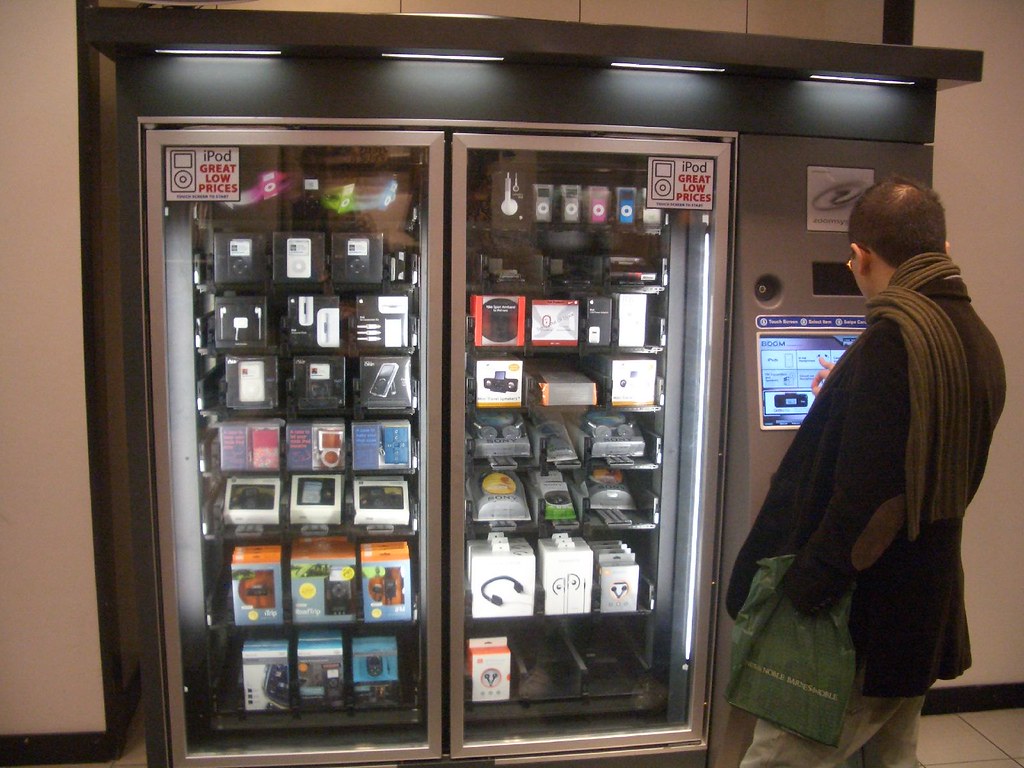
The last time I was in New York, my hip younger sister took me to a really cool vending machine.

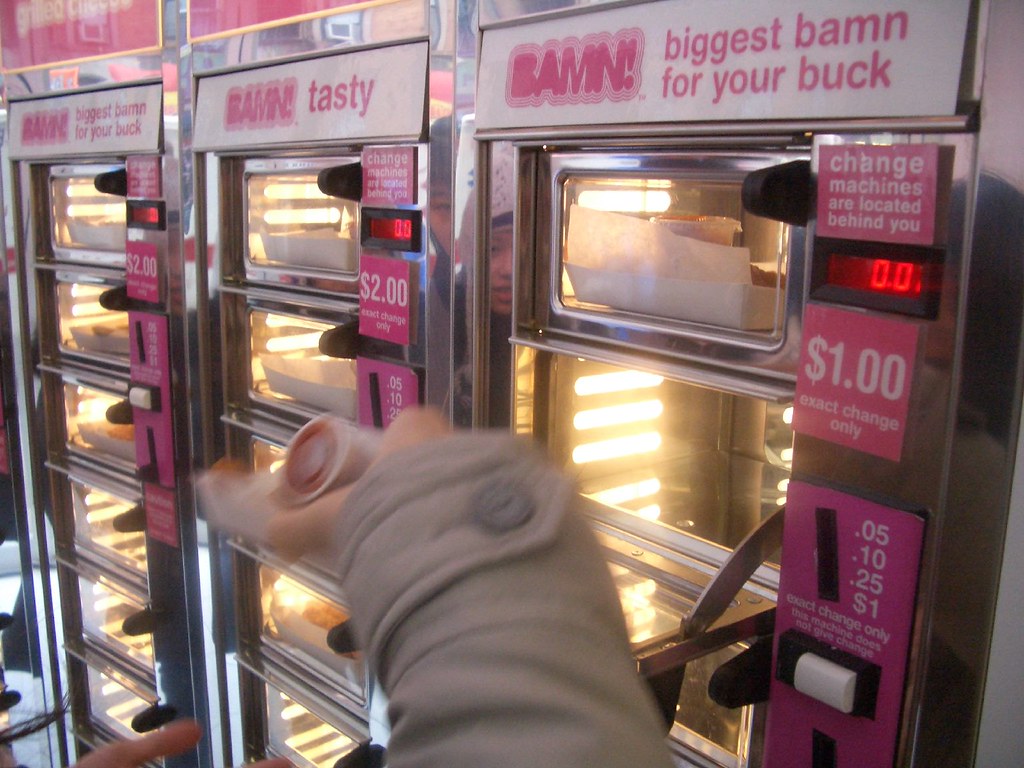
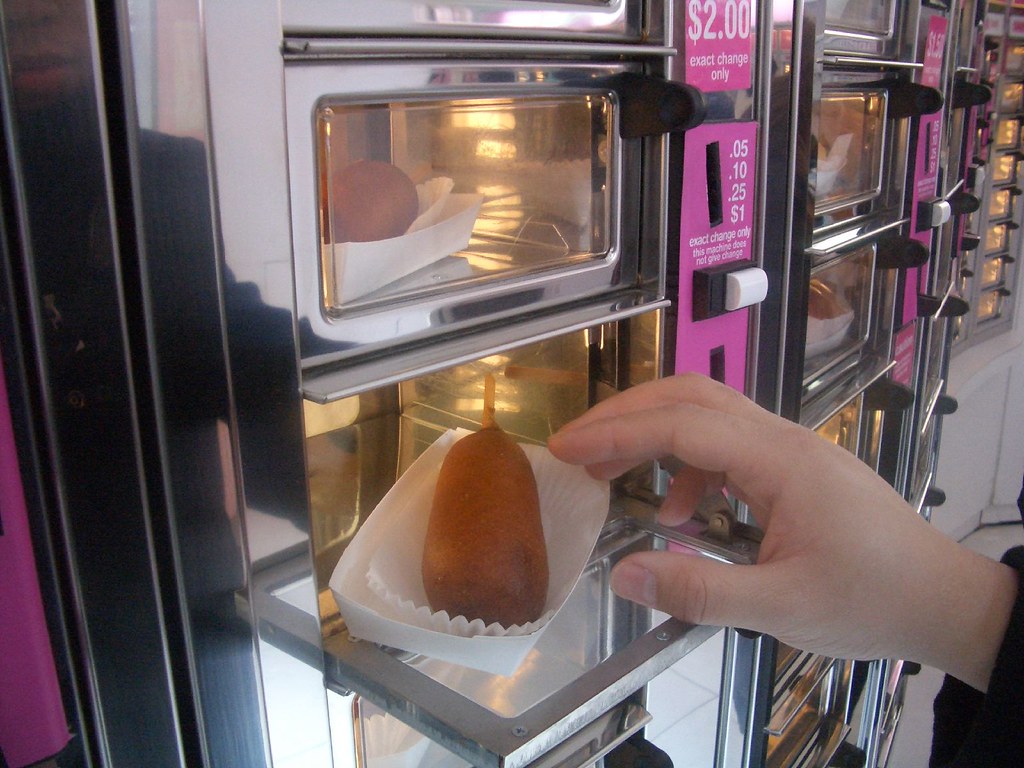
No, seriously. It's a humongous vending machine, with a whole storefront built around it, and a whole kitchen behind it. A bunch of people work at this vending machine, supplying it with fresh, hot snacks.

And I am not talking about chips and pretzels. I am talking grilled cheese, chicken wings, pizza and piping hot donuts.

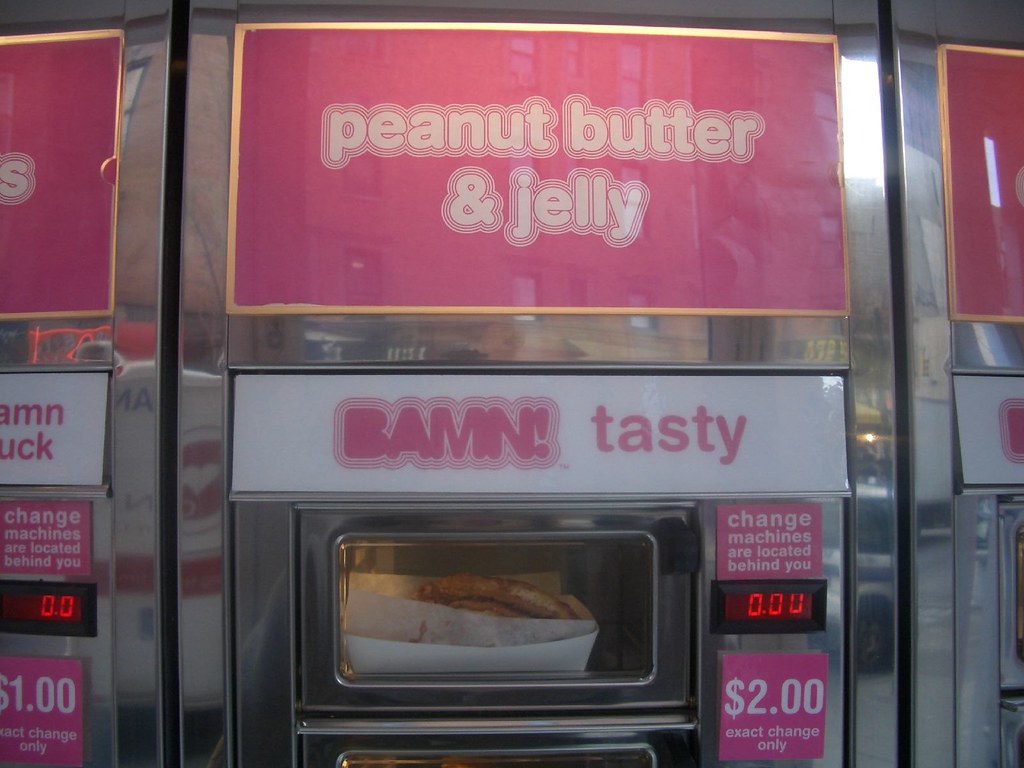
The place is called Bamn. It's a recent version of a much older concept, called the Automat, which last dotted New York's late-night scene in the 1940s. Big banks of vending machines were serviced by cooks in the back, and the places had real crockery, metal utensils and seating for people seeking a fast, cheap bite.

Today, the atmosphere is different and so are the customers. Those crazy kids come in at all hours of the night, pop two bucks in the change machine, and grab their corn dogs and peanut butter sandwiches. Then they continue on their walks of shame. Bamn has no seating, no waiters and no time wasted. It's the epitome of modern, urban convenience.

Now granted, this place is a gimmick. It's not much different from any burger dive - same greasy food, same rock bottom prices. The only difference is the machines.

But for commodities like fast food, I would argue that the machines provide a refreshing twist on the original. Has a Burger King employee ever truly brightened your day? Chances are you leave most fast-food counters feeling bored at best, angry at worst. And burgers are a commodity. At this point, you can compete on taste or you can compete on price. Most compete on price.

Now, let me be very clear. I think Bamn works for two reasons. The product is a commodity and the service is unnecessary. Vending machines deliver the product, effectively and efficiently, and no love is lost when no humans are present. But folks, vending machines are popping up in all kinds of crazy categories! And I think it's getting out of control.


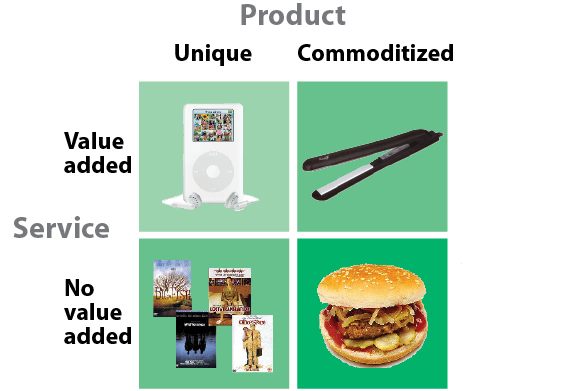
Let's start with the bottom right. When the product is a commodity (low prices, little differentiation, readily available) and the service isn't adding any great value, then I say, vend away. Exhibit A: Bamn. Great job, guys. Way to catch a trend.

Next. Top right. Sometimes, the product is undifferentiated but the service can add great value. Example: hair care. You can blow dry your own hair with any generic dryer, but real women pay $20 and up to have someone do it for them. That service adds a mighty margin to an otherwise basic offering. So I don't think vending machines are necessarily going to boost this market, unless they can provide something that current services do not.

Enter Beautiful Vending. Its hair-straightener vending machines are popping up in women's restrooms all over the UK. One pound buys two minutes of time with a hot iron. This is smart because it creates a new usage occasion. Vending machines provide what beauticians cannot - ubiquity. Place one in every bar, and suddenly the entire hair care market expands.

Bottom left. Sometimes, the product is unique but the service is nonexistent. (Exhibit B: the chump at your local Blockbuster). The DVD market is crowded, and as Americans increasingly choose home over theater, lots of firms are dying to deliver movies to your set-top box or mailbox. Again, I think most shoppers' needs are being met, and the only way vending machines will grow the market is if they provide real improvement over existing models.

Enter companies like DVD Now. Its DVD vending machines are making waves at the grocery store, the drug store, and wherever shoppers make routine, weekly visits. One benefit rises to the top: the machines only carry new releases. No wasted space for box-office flops. So let's say you're not a huge movie person, and you don't subscribe to Netflix. Then you probably just want the hottest summer blockbuster. This machine helps "low-commitment shoppers" cut to the chase. It provides an easy solution for a new type of customer, thereby expanding the market for DVD rentals.

This brings me to the top left. Sometimes, though very rarely, the product is so unique that it creates and dominates a revolutionary new market. Sometimes, the product puts a company on the map and singlehandedly facilitates its turnaround. Sometimes the service surrounding the product is adding so much value, it can be described as the world's most amazing retail experience.

This is perhaps the only time where I would say that a vending machine is not going to help. In fact, it's going to hurt.


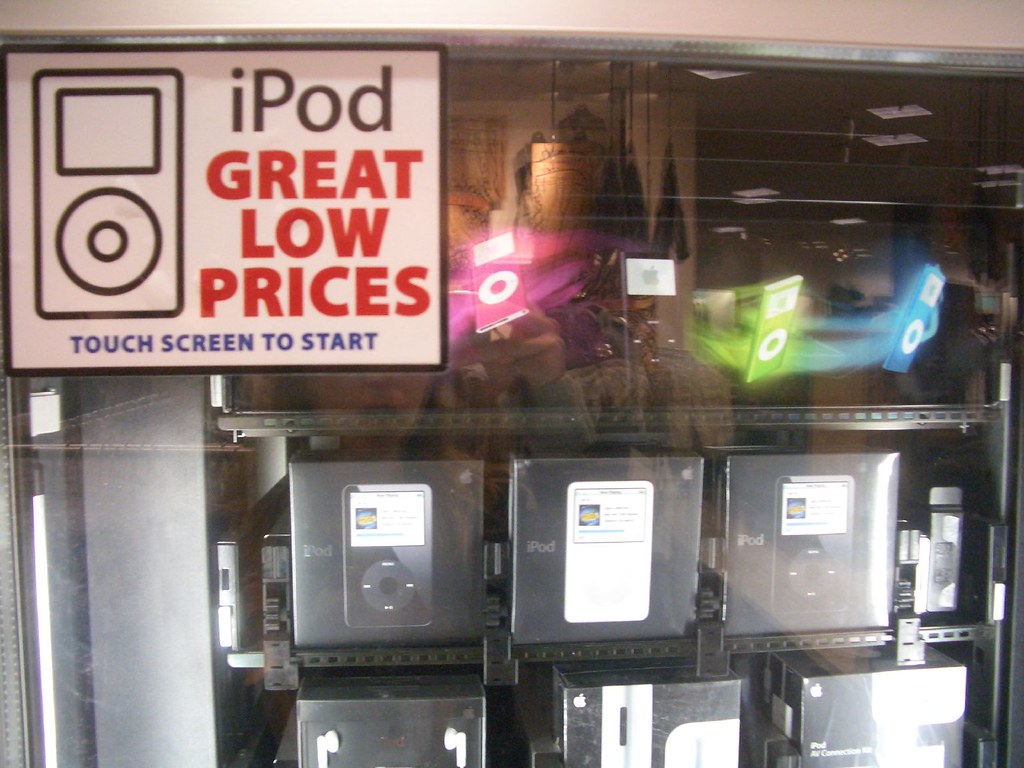
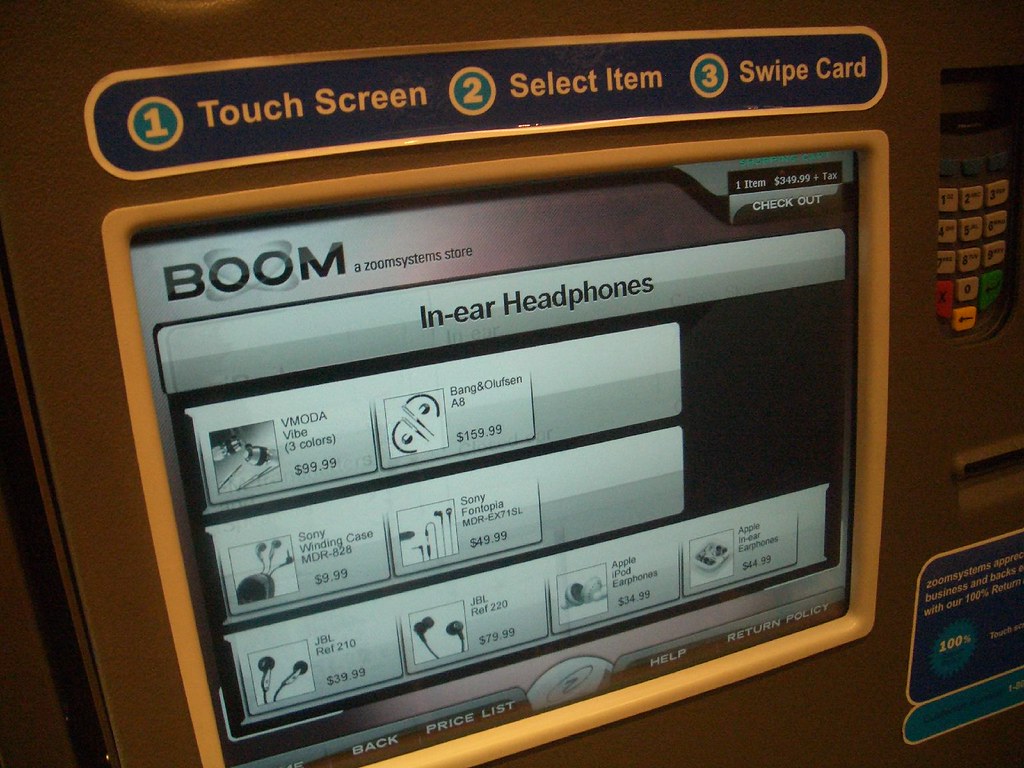
Ouch. Yes, those are real iPods. And real Bang & Olufsen, Sony and JBL accessories. They aren't cheap items. But their markdowns are being advertised loud and clear.


Great low prices? Is this a grocery store? Are we in Wal*Mart? Has anyone ever bought an iPod because it was cheap? Apple, talk to me. Are you trying to commoditize your product? Trying to undercut your outstanding service? Make it unnecessary for shoppers to visit the Apple Store? What can a vending machine possibly bring to your incredibly successful table?


Apparently it can bring a touchscreen interface. And that's about it. I don't see how this vending machine helps the iPod market. Its location doesn't expand product usage - this one was spotted in Macy's, where I can't imagine shoppers are in the mindset for electronics. It doesn't attract a new type of customer, unless you count the kind of customer who's hungry for a Snickers bar. (They're walking around Macy's, feeling hungry, they see a vending machine, and boom. They're looking at iPods. Unfortunately, now they are confused AND hungry).

No, this concept seems to only be providing more iPods in more places. And that is not such a good thing, because it will cause them to lose value. It's the law of supply and demand. Quite frankly, this vending machine has got to be the worst idea I've ever seen at retail. And folks, that's saying a lot.

---

You might be saying to yourself, "Everyone else is putting their products in vending machines, maybe I should too!" Well, I encourage you to consider within which quadrant your product currently lives. Is it already commoditized? Does it need a nudge in the other direction? What's your service experience like? Can a machine add value that a human cannot? Do vending machines make any sense at all?

For help answering these questions, I encourage you to refer to my handy vending machine planner's guide.


I hope that by now, this is self-explanatory.

5.08.2007

Thinking outside the vestibule

Disclaimer: this story happened about two years ago.

Disclaimer to the disclaimer: it's still pretty insane.

---

So in the city of Chicago, you don't really need a car. Depending on where you work, it is often quite feasible to commute using public transportation. In the spring of 2005, I was finishing up grad school and planning for my new life which included, among other things, finally buying a car.

But on this particular day in April, I did not have a car. What I had was a check, a check that desperately needed depositing. I was low on funds, and I'd made a regrettable transaction that would put my account in the red within 24 hours. Plus, I was going out of town the next day. So basically, it was now or never. But I wasn't worried. I walked out of my house and down the street, to my local LaSalle Bank.

I've been a customer of LaSalle Bank for almost ten years. I think I joined out of necessity; they were the prescribed bank of choice for Northwestern students when I was a freshman. But I'm fine with this. In their many years of service, I have found LaSalle to be convenient, consistent and pleasant. Hardly a blip on the radar.


So it's Friday, and it's 6:30. The branch closed at 6. Shoot. I walk around the side, and the drive-thru is open until 7. Sweet. The outdoor ATM is obviously open too, so I try that first. But this particular ATM decides to be "not accepting deposits at this time." Shoot.

Still, it's no problem. The drive-thru teller's window is open for another half an hour. So I wait for a car to drive away, and then I walk up to the window. There's a man sitting behind the glass. I give him a smile. Then, because I think I'm a pretty funny girl, I make a gesture like I'm resting one hand on the steering wheel.


He doesn't smile. I use the other hand to gesture "honk honk" on my imaginary horn.


Nothing. Confused, I tap the glass.

"I'm sorry ma'am, but this window is for customers in cars."

He's obviously joking, so I laugh and shake my head. "Oh, right! Heh heh! Yes. Good one. Now I really need to deposit this check."

"Ma'am, I'm very sorry. But I can't perform that transaction. This window is only for customers in cars."

The city noises fade to silence in the background. All I hear is the echo of his words: "Customers in cars...cars...cars..."

"Wait, you're serious? But your lobby is closed! The ATM is broken! Sir, I need to deposit this check. My account is going to go under. Can't you just take it? Please?"

"I'm sorry, ma'am."

Wow. I'm dumbfounded. I slowly take a couple steps, then stop. Then look back. My confusion turns to anger. Customers in cars? That doesn't make an ounce of sense! Here I am, a loyal customer for eight years, and because I'm not seated behind the wheel of a paycheck-eating, gas-drinking, life-endangering and wholly unnecessary motor vehicle, he won't serve me? What could possibly be the reason for this?

Is it safety? Will I get run over by the car behind me? Or is it validation? By having a car, am I somehow proving myself to be a worthy LaSalle Bank customer? Or is it just a policy? A policy that sounded good in the positive - "Our drive-up is for customers in cars" - and was now being interpreted by its corollary negative - "Our drive-up is NOT for customers NOT in cars."

Whatever the reason, I was pissed. I turned to face the traffic going by. And then, I had an idea.


It took me about seven seconds to hail a cab. I leaned in and told the driver to turn around, that we were going through the LaSalle Bank drive-thru. The cabbie was confused, so I quickly explained what had just gone down.

"THAT IS BULLS--T!" he roared in a thick accent. This dude got mad so fast, I barely had time to slam the door before he stepped on the gas. Perhaps he was someone who had experienced this kind of inept corporate bureaucracy himself. Either way, he was on my side. We squealed around and pulled up into the teller lane.

The cabbie rolled forward until my window was lined up with the bank's window. There was a split second of awkwardness, and I asked him to please roll down my window. Then I saw the teller's face, saw it change from confused to embarassed.

"Hello! Hi there!" I waved with a big obnoxious grin. "Here I am! In a car! I'm a customer, and I'm in a car! Just like you said! NOW PLEASE TAKE MY CHECK."

And you know what? He did. After a moment's hesitation, he opened the slot and, through the backseat window of a Chicago Checker cab, I handed him the envelope.

---

Customer service is a balancing act. For most companies who have retail locations, spread out across a region or country or planet, headquarters has to decide what to control, and what to let go. Depending on the company, one of two strategies tends to emerge.

Some companies empower their employees, viewing them as an asset. They decentralize decision-making and equip their workers with the tools to make good choices. These companies trust their store managers to display products the right way in each local market. They trust their salespeople to say the right thing, without enforcing a script. They provide employees with tips and frameworks, but leave enough room for interpretation that former drones turn into humans.

Other companies control their employees, viewing them as a liability. They standardize operations and issue strict guidelines. One small improvement can save millions of dollars, while one small mistake can cost even more. These companies provide machinery so advanced, it can cook a burger with zero opportunity for error. They send their drivers on step-by-step routes that minimize the use of left turns. They limit their workers' accountability, preferring to keep them on tighter leashes. They might make fewer mistakes, but they also make fewer great impressions. Plus, their workers are inevitably reduced. Humans fade away, and drones emerge.

Of course, different employees in different areas of a company will have more or less autonomy - depending on things like experience, customer interaction and the task at hand. I'm guessing that someone making fries at Mickey D's does not have permission to say, "I think I'll try adding cinnamon!" Whereas someone managing the same restaurant is empowered to grant the customer a refund, if the fries were sprinkled with nutmeg.

But there is an obvious contrast in the level of empowerment between comparable employees at different companies. You can just sense it. How much "the rules" matter becomes evident when you are redeeming just-expired gift cards, for example, or when you have to show two forms of ID and you only have one. Basically, the rules only matter when they are being questioned. And whether or not the employee is "allowed" to break the rules often makes the big difference in the do-or-die issue of customer loyalty.

Ultimately, I believe it comes down to a fundamental trust in people. And hey, I'm not saying every company has to trust all its employees. Not every stock boy is the sharpest tool in the hardware department. But employee empowerment is a self-fulfilling prophecy. If you limit people, they will behave with a limited outlook. They'll blindly follow rules because they weren't trained to think otherwise. But if you trust people, and empower them with training, they will see the rules from the viewpoint of the customer. Empathetic employees - isn't that what everyone wants?

---

It was recently announced that LaSalle Bank is being sold to Bank of America. A new company will come in, change the rules and present its own philosophies on customer service. Maybe they'll have trusted, autonomous employees. Maybe they'll have some wonky policies of their own. I only hope that if one day, I walk up to a drive-thru, they'll take my deposit.

4.21.2007

Public or private?

Last night, I found someone else's shopping list.

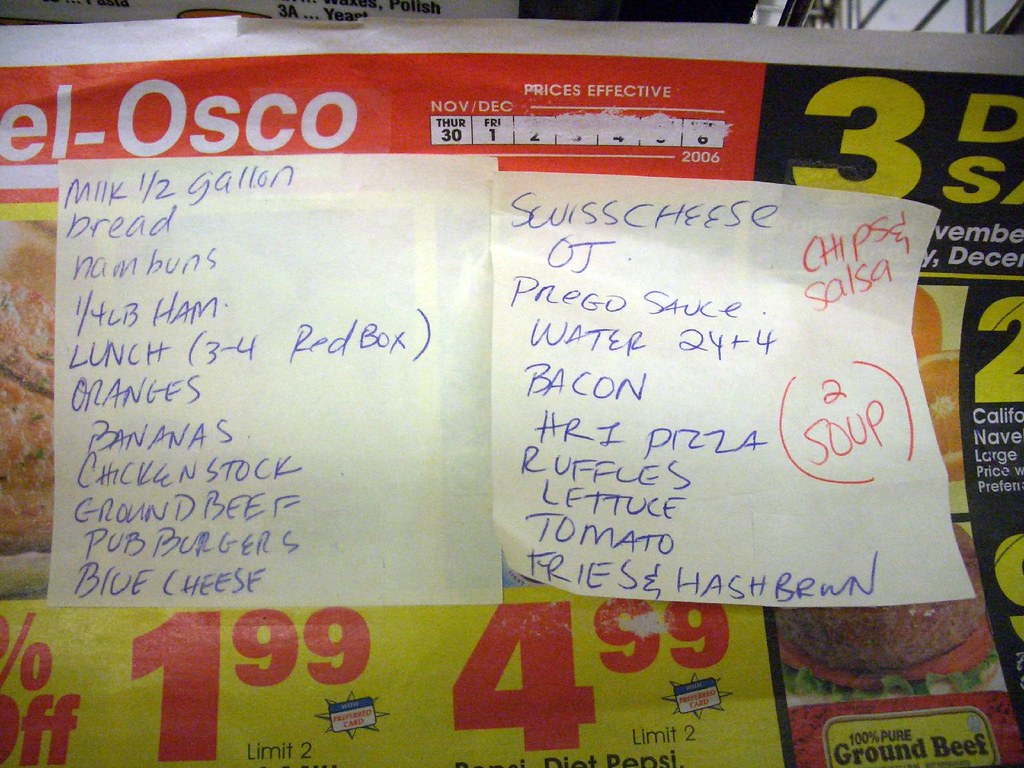
I was making my way through the produce section when I looked in my cart, and there it was. Stuck to the in-store circular on two Post-It notes.

And you know what? It stopped me in my tracks. Maybe I'm just nosy, but I felt compelled to stand there, read it, and imagine an entire life story about the person who wrote it.

Now I suppose the list wasn't all that unique. Milk, OJ, bread, cheese. Bor-ing. But I couldn't help digging deeper. What tidbits could I glean about the author of this list? Who was this woman?

And I was sure it was a woman. Most shoppers are women, the handwriting was feminine, and the way it was stuck to the coupon pages – oh yes. This was a money-saving mom with a family at home. I know that part because she was buying "Lunch," which consisted of "3-4 Red Box." That sounded like juiceboxes to me. Though why only 3-4? There are five schooldays in a week. Maybe her kids buy lunch on Fridays?

Or maybe she wasn't a mom. Maybe she was getting frozen insta-lunches and they come in a red box. Because I noted that while lunch and dinner were present, breakfast was conspicuously absent. Does she skip breakfast? Maybe she's a busy career woman. A Starbucks drive-thru kind of gal. Maybe she wrote the list, and her assistant is doing the shopping!

Though she was definitely planning an event. Maybe a barbecue. That would explain the burgers, buns, lettuce and tomato. And two items were added in red, chips and salsa and two soups. She must have noted those down at the last minute. Does she keep a red pen in her car? Is she a schoolteacher? Why was she having a barbecue when it's 40 degrees outside anyway? What will she cook with the chicken stock? WHAT'S INSIDE THE RED BOX?

All this went through my head in a matter of seconds. It was surprisingly intimate. I felt a little guilty, like I had violated this person’s privacy. Like I'd peered in her closet or dug through her fridge.

But it was also intriguing. Knowing the personal details of someone else's life is strangely fascinating. And a shopping list contains lots of these little clues. Because what we buy is a direct reflection of who we are. Are we brand-conscious? Price-conscious? Health-conscious? Impulsive? Consistent? Lactose-intolerant? I could speculate for hours about this woman's job, family, appearance, cooking abilities, social life, budget and values.

But here's the question of the hour. Do you think she would mind?

---

Privacy is simultaneously becoming more and less important these days. Because as a society, our trust in each other is getting paradoxically larger and smaller.

On the one hand, some types of information are becoming more public. Our likes and dislikes, our jobs and hobbies, even our love lives and biggest secrets are being put on display. We all want to know more about each other; there's something in human nature that compels us to seek this out. And our desire is being met with increasingly “real” versions of real life - from the Jennicam to Justin Kan's life on camera. There’s a popular Flickr group called What's In Your Bag, where people spill, sort and photograph the items in their purses. You might be asking yourself, who cares what's in my bag? But trust me. People do.

On the other hand, some types of information are becoming more private. Our social security numbers, sure. But also our email addresses, our receipts and our mail. Privacy is now a big deal on a national scale. Fears about identity theft and government security and "the dangers of the internet" run rampant, especially with older generations. We all have 37 different passwords. The shredder market is booming.


Now the store is a great arena to watch this all play out. The information at stake is simply, "what we buy." Should what we buy be public or private?

Well, the items in our cart are on full display. We don't own them, and everyone can see them. They are public. Yet when we get to the checkout, we don't like other people staring at them. They are put in bags. Now they are private. But once we unpack, some of us write the items up on our shopping blogs. And others leave lists in their carts. So in one sense, maybe we don't mind our purchases being public.


But if the main trend is transparency, its countertrend is an increased concern for privacy. Because here's what many people don't know. Stores collect personal data on what we buy. If you've ever shopped with a loyalty card, like the Tesco Clubcard or the CVS Extra Care card, you have shared your purchase information with the store. The same personal tidbits that I saw on the list, but with greater accuracy, scale and detail. (They know, for instance, what's in the red box). Stores record our purchase behavior, and pass it onto companies like dunnhumby, who use it to conduct "relevance marketing." In other words, our unknowing card swipes are helping them make all sorts of decisions about products, prices and in-store advertising. They can slice and dice their customer base to their pie chart's delight. It's powerful data.

But is this an invasion of privacy? Some people say it is. These folks opt not to use loyalty cards, and their purchases remain anonymous. But guess what - they lose out on the savings that cardholders enjoy. And I don't think that's fair.

So just like the choice at the end, "Paper or plastic," I believe we should be given a choice up front: "Public or private?" And stores should work to give both kinds of shoppers an experience that meets their needs.

Shoppers who "go public" can elect to share what they buy with, well, everyone. Their shopping lists are on full display, broadcast throughout the store with their personal profiles. They sign up for free samples of products they enjoy, see where they rank in shopping contests, create universal wish lists, and see what they've bought in the past. They give feedback on products, get recruited for market research, and discuss favorites with fellow customers. They essentially live lives of shopping transparency. These are all natural desires, and the stores should help fulfill them. But the one thing "public" shoppers shouldn't get is a price break.

Likewise, shoppers who "go private" can elect not to share what they buy with, well, anyone. They push around carts with opaque covers, so that nobody can see their items. Their receipts are blank except for the price. They are happy to get what they need, while remaining respectfully anonymous. And they aren't docked financially for feeling this way.

Because while I don't think that money is the best way to incentivize people to share, it's the tactic du jour for getting shoppers to give their demographic information up front, and their purchase information over time. Rather, shoppers who want to go public should be given channels to share, and shoppers who want to stay private should be equally accommodated. The store would save money on all those coupons, too.

As the privacy wars are waged on nearly every front, and a new generation grows up with high expectations for transparency, the question of To Share or Not To Share may well perplex leaders in every industry. I wonder what retail will do. Because right now, we are seeing Privacy 1.0. A couple pennies saved by a bunch of naive consumers. Rather, I envision a space where we choose all sorts of privacy preferences, and customize our sharing options in every store.

---

So, do you think the anonymous shopper would have minded that I was poring over her list? She left it in a public place, after all, and I suppose my snooping was harmless enough. Would she care if I posted it on my blog? What if I started sending her coupons for chicken stock? Would she mind if I lumped her into a "shopper demographic" and made money off my knowledge of her choices?

This is where it gets tricky. It's a soft line between what's okay to share and what's not. But it's a hard line between using someone's info for entertainment, and using that info for profit. So my guess is, no, she wouldn't have minded that. But she might mind this. I'm sorry, anonymous shopper. Your story just had to be told. Maybe next time, you won't leave your list in the cart.

4.16.2007

Curious Shopper for president!

This site was nominated for a Best Shopping Blog award. Help me scratch and claw my way to the top! Cast your vote here.

3.25.2007

Repetition, repetition, repetition

Q: How many sweaters does it take to sell one sweater?

A: Apparently, more and more.

Confused? Read on.

---

I recently visited New York City and, like a good curious shopper, spent some time in stores. It's all for you, people.

So there's this new store called Uniqlo. It opened its US flagship in Soho last fall. Uniqlo has been hailed as "the Gap of Japan" for selling basic, mainstream, simple - all right, boring - clothing. But that's okay; boring clothing at reasonable prices has sold well in Japan.

However, Uniqlo has been challenged to translate its retail offering into other cultures. A first attempt at the UK market failed when big, splashy store openings were met with confusion. Now, Uniqlo is focused on bridging the culture gap, by understanding the mind of the fickle US consumer, while also maintaining a subtly Japanese aesthetic. They've set some lofty goals with that one.

When I visited the store, I had a slightly different observation. For me it was less of an American-Japanese gap they needed to bridge, and more of an Old Japan-New Japan gap that needed balancing. I saw spare Japanese discipline coupled with hip Japanese pop culture. The interplay between modern and traditional was fascinating, if not entirely cohesive. Most interestingly, the traditional was actually more in tune with the trends of American retail.


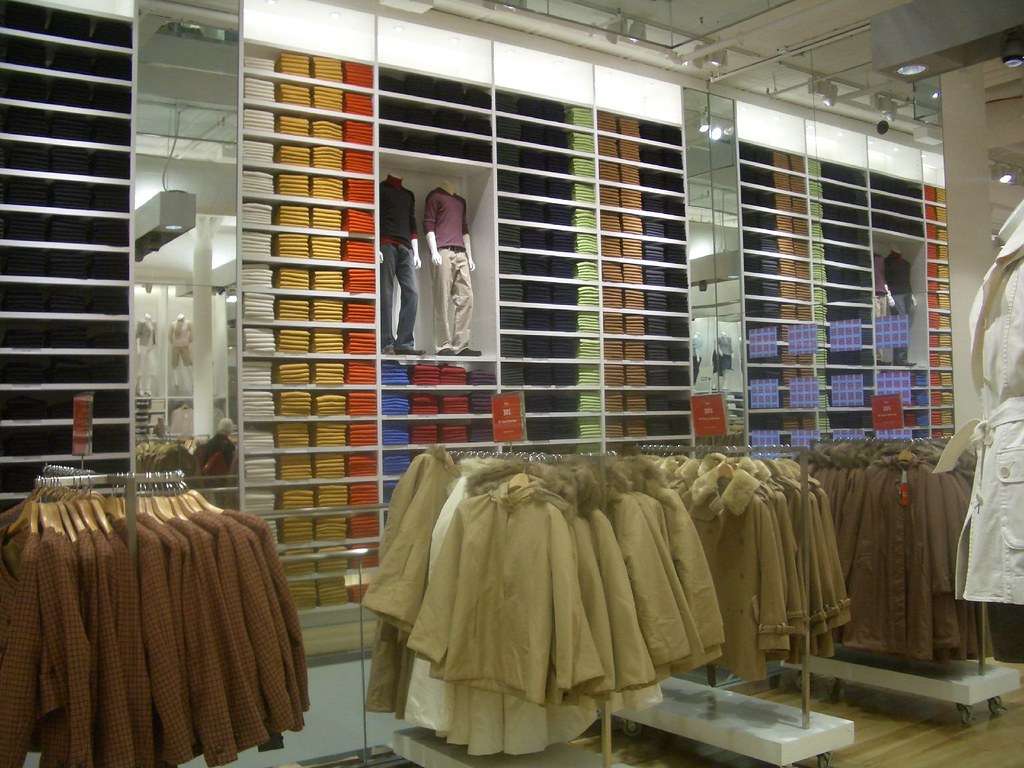
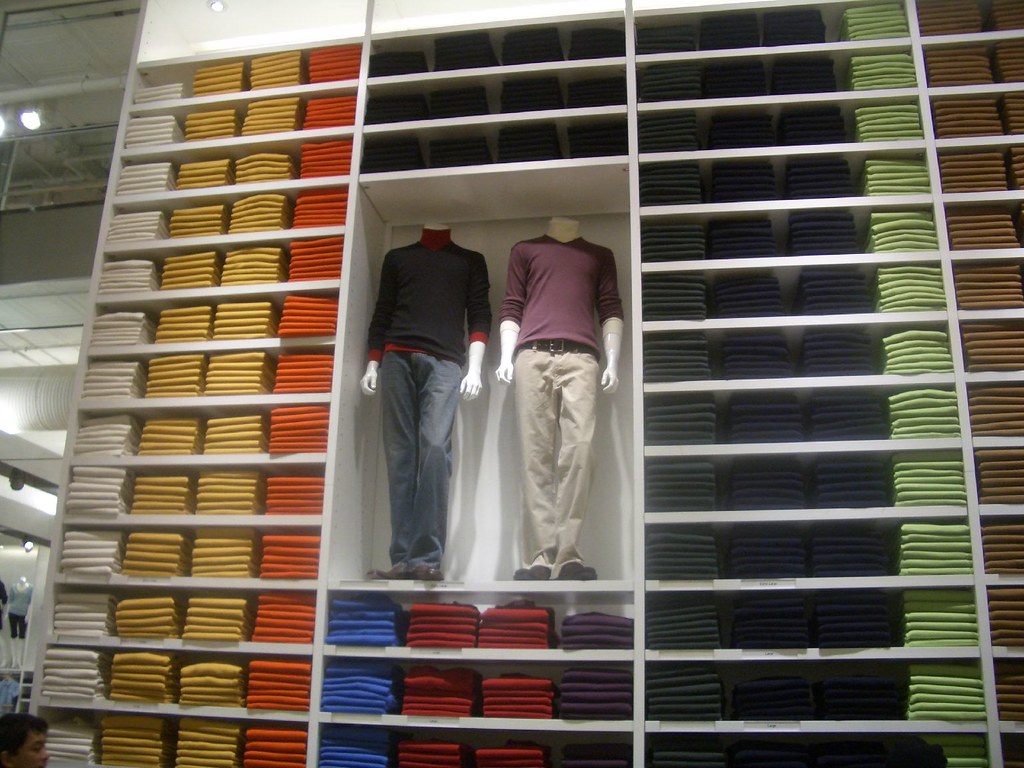
The store is 80% minimalist. The clothes are unbranded and consist mainly of plain, solid colors. Everything is neatly organized and placed on a giant three-dimensional grid. The whole environment is sparse and geometric. It feels vaguely Asian. It feels kinda rigid. It doesn't feel like clothing, and it doesn't exactly inspire me to grab five tops and jump into a dressing room. And yet, there's something intriguing about it.


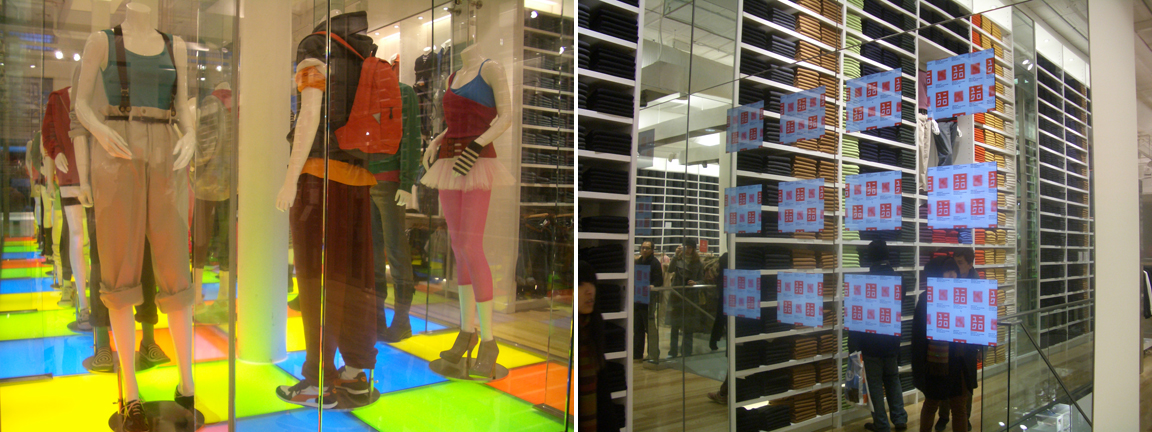
But the other 20% of the store is sensational. Flashy mannequins are decked out in Japanese street fashion, spinning in a disco-hipster aquarium. Flat-panel televisions, mounted flush with mirrored walls, create an eerie, futuristic vibe. It suggests fast-paced youth culture in Tokyo, like the club scene in Babel or the karaoke in Lost in Translation. It feels uber hip. It also feels kinda lonely. It reminds me of the isolation of technology.

Now ultimately, I believe that Americans are hungry for a dose of non-American culture. And saying "I got this at Uniqlo" will give New Yorkers their weekly dose of cool. So the flagship should do very well, and it has so far. But while J-Pop is a fad here in the States, the design elements of traditional Japan are a trend. Know the difference? Fads come and go. Trends are indicative of longer-term changes afoot.

And one of the biggest retail trends I see today is simply, repetition. Why? We are busy, and our attention spans are short. Show us something once, and we might sense it with peripheral vision. Show us something twice, and we recognize it from before. Something triggers our brain to remember it. Show it to us again, and we might actually process it. Show it to us so many times, that it becomes part of something bigger? Now we really get it.

Here's an example. You know how people complain about the grocery store having 40 kinds of ketchup? It probably doesn't have 40 kinds. It might have 15 kinds, but 40 facings. This is because stores give top sellers multiple spots on the shelf. Let's face it, a ketchup bottle is only so big. It can't grab your attention on its own. But an army of ketchup bottles? You are guaranteed to see at least one of them.

Another example. I've seen ads plastered onto el cars in Chicago, and on bus stops in New York. The single ad may be a well-designed, fully complete, standalone poster. But there are three of them in a row. I've learned to ignore most commuter advertising, but triple-vision ads? It's odd and it grabs your attention.


You may be saying to yourself, "But repetition is so obvious. It's the oldest trick in the book." That may be true, but it wasn't always necessary to repeat. Think about it: in the past, stores might have only needed one can of soup to sell, well, one can of soup. Now, apparently, they need two. Repetition has gone from a bonus to a requirement.


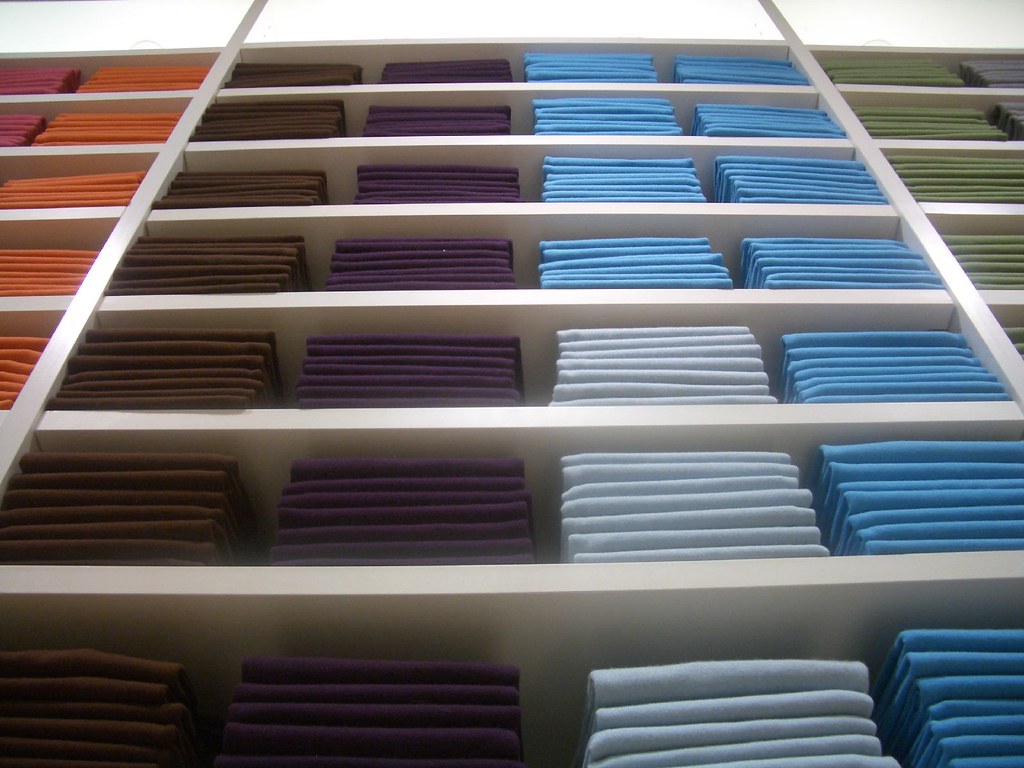
And what Uniqlo has done is take repetition to the next level. The store uses the product to create an enormous wall of color, much bigger and more impactful than any single sweater. When you stand across the room, you sense the pattern and the scale. When you get closer, you recognize the individual items. When you unfold one of the 6 sweaters that are actually within your reach, you feel like you're taking a piece of the Great Wall of China. It's special, because it's part of a much bigger entity.

If retail is a game of attention, this billboard effect is the newest way to win. And so for me, it all came together. Uniqlo may not be in vogue forever, because nobody knows how long Japanese culture will be cool to Americans. But the principles behind Uniqlo's retail exhibition are right on trend. They are actually more in sync with the most basic form of retail out there - the supermarket. Uniqlo might not feel like other clothing stores, but it sure does feel efficient. Packed and organized like the best cereal aisle.

---

The answer, by the way? Well, it looks like there are about 12 stacks of 6 sweaters above each eye-level section. So, by my calculations, 72.

2.21.2007

Stand by your fish

One recent evening, I happened to wander into a Petco. It was very different than the pet stores of my childhood. Instead of wide-eyed children gazing at puppies and bunnies, I saw two things. Supplies and fish. Apparently, Petco has scaled back.

Or maybe it's always been this way. I can't imagine that a national chain like Petco wouldn't be able to logistically handle dogs and cats, but perhaps those are better left to independent breeders and animal shelters. Or maybe puppies are just low-margin merchandise. (Sorta breaks your heart to think of it that way, huh?)

But you know, the longer a puppy "sits on the shelf," so to speak, the more expensive he becomes to maintain. Employees have to feed him, walk him and love him, and even at minimum wage, all that loving can get expensive.

But a fish has got to have better shelf life. And I'd imagine the markups are decent. So perhaps supplies and fish were more of a business decision than anything else. After all, Petco is a business too. Even though it's peddling love and appealing to shoppers' emotions, it's still a large corporation with shareholders (or recently, private investors) to please.

Anyway, I am not in the market for a pet of any species, but I had some time to kill. So I decided to browse the fish aisle. There I was, gazing into tanks and making pucker faces, when I noticed a small sign.


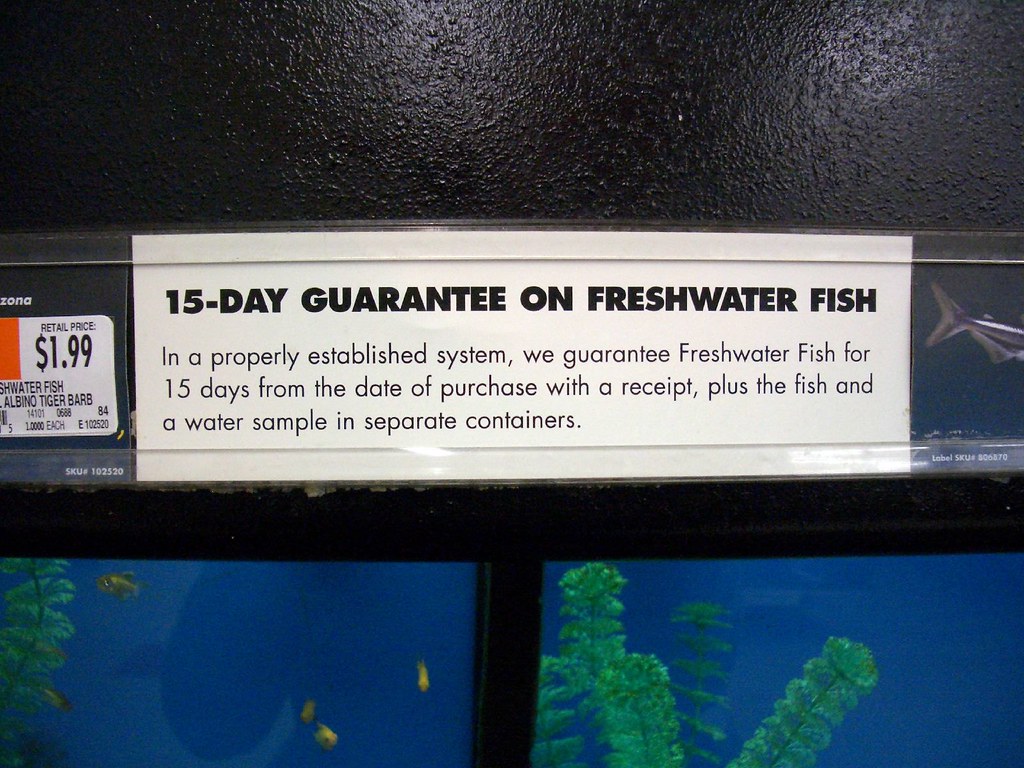
"15-DAY GUARANTEE ON FRESHWATER FISH. In a properly established system, we guarantee Freshwater Fish for 15 days from the date of purchase with a receipt, plus the fish and a water sample in separate containers."

This was unlike any return policy I have ever seen. I'm going to take it one phrase at a time.

First, Petco is saying their fish will live for 15 days. I don't know if you've ever had a pet goldfish, but in my experience, lifespan varies widely. We'd come home with four new fish in a bag. One would be dead that night, two more would go in a month, and the last one would live for five years. So how they heck are they providing this sort of guarantee? Do they inject their fish with 15-day miracle vitamins? I was skeptical.

But then, they specify a "properly established system." Upon inquiry, it turns out that a proper system takes all sorts of factors into account, such as water temperature, filters and lighting. The Petco employee had a whole bunch of take-home literature on how to properly establish your system. It was actually quite useful, and I'd imagine that if I were buying my first fish, I would read up. So maybe this guarantee has an educational benefit. But I still wasn't totally convinced. Would anyone else make the effort to learn?

Finally, you not only have to bring a receipt, you have to bring the fish. THE FISH. They are not kidding around! Apparently dead fish transportation receptacles have recently included Tupperware containers and pillboxes. Oh, and a water sample. You have to save some of your dead fish's water for inspection. Doesn't this seem like a lot of work for one lousy free fish?

Apparently, it's not. People are indeed taking advantage of this fish guarantee. And I actually think it's quite clever. Petco knows that fish are notoriously short-lived, and I have to imagine it was getting multiple complaints a day, from angry shoppers, about dying goldfish. So the folks at corporate must have realized that the best way to take control of the situation was to give some responsibility back to their customers. Petco can't be liable for every dead-pet heartbreak in town, but it can carve out an area where its responsibility ends, and the customer's begins.

So they wrote this return policy in no uncertain terms. I imagine it's quite effective.

First, there's the education opportunity. The "properly established system" part means that if you didn't read our guidelines, it's your own fault. Imagine what takes place when a customer brings back Fishy. The employee gives him a little fish physical - takes his temperature, looks at his color and size. Then she tests the water's chlorine levels and looks for foreign particles. If something is up, the employee can diagnose it, teach the person what went wrong, and instruct them on what to do differently next time. It's like saying "We told you so" in the nicest of ways. Plus, education is rewarded; if you did everything we told you, then it wasn't your fault and you will get a new fish.

Second, there's the emotional response. I'm sure this is disproportionate for fish. I mean, if your toaster breaks, that is irritating. But when your child's new friend kicks the bucket, that is a sad day. A very sad day. That child is in the darkest hour of his little life. So just when Dad is most pissed, and Joey is most distraught, in swoops Petco to save the day. Joey learns a valuable lesson in the transience of life and death, and Dad learns to read the fine print. I'd imagine this return policy wins major points with parents.

And third, there is the business impact. Which is basically, zero. How much do you think a fish costs Petco? Ten cents? Small investment for what must be big rewards. They'd probably have to give away a free fish, every 15 days for a year before they lost money. And I'm sure someone did the math. Maybe they found that 10% of their stock typically die in less than 15 days, while the other 90% live longer. Ten percent of inventory is pretty manageable. Many retailers make similar estimates regarding their own "shrinkage." I'm sure the fish warranty makes only the tiniest of dents in the bottom line.

Education allows for loyal, informed customers. Replacement allows for happy children. And education + loyalty - small cost = big value. Good job, guys.

PS: I thought perhaps Petco's policy might give it a leg up on PetSmart, its arch nemesis. A quick call told me that PetSmart only offers a 14-day fish guarantee. Ha, ha. How's that for a competitive advantage?