Showing posts with label service. Show all posts

1.19.2009

There is no right answer

This year, one of my New Year's resolutions was "Suffer more for beauty." And I'm pretty pleased with this resolution. I mean, I'm not wearing mom jeans over here, but I'm definitely the kind of girl to choose comfort over style. Hence, my shoes are all flats, my makeup is minimal, and I never, ever blow dry my hair.

But this year, I decided to take a stand against comfort. I'm 29, for god's sake, and if I don't look my best now, well, it just might be downhill from here. So I bought heels. They crunch my toes, but when I wear them at work, I get a little confidence kick. I bought makeup I've never had before - concealer, eyebrow pencil, a nice new blush. I even sprung for a curling iron. I'm spending more time in the mornings, but I'm feeling better when I walk out the door.

Encouraged by my resolution, my sister got me a Sephora gift card for my birthday. A lovely present. However, before hitting the store, I decided to peruse their website. You know, to prepare myself for the crushing tide of possibilities.

I find beauty stores extremely overwhelming. The issue is simple: how can you possibly know if this facewash or that lipstick is going to change your life? They all say they will, so which one can you trust? I usually end up going for a brand I know, or the nicest packaging, or something that smells good. But this time, I wanted to arm myself with a bit more information. A little pre-shop on the website would surely help with that.

And it did. As I scanned the hair-care products, I noticed little tags that said "Best of Sephora." Now this, I like. This I can get behind. Because it's based on data. I clicked on a "Best of" styling product, Frederic Fekkai Glossing Cream. I assumed the tag meant that this product had more reviews, and more positive ones, than all others like it. So I started reading.

"This stuff is so addicting it is my personal hair crack."

"Works wonders on my hair."

"Boy! This stuff works so well."


"This glossing cream will make your hair shine! I always get compliments when I use it."


"Up until I discovered FF, I sort of begrudgingly bought hair products, because I never saw the results I wanted and felt like I was throwing money down the drain. However, this line has totally changed all of that.
I like this product because it doesn't contain any alcohol, and really moisturizes your hair. I've colored my hair this past year and this has saved my hair and really reversed much of the dryness that was making my hair unmanageable."

That last one really stood out, because I can relate. I too have bought hair products begrudgingly. I too have seen a lack of results. I too have dry, colored hair.

Plus, many of the negative reviewers said things like, "I used too much and it didn't work." Idiots, I thought. I noticed myself selectively filtering out the negative reviews, and becoming more and more excited with each positive one.

Now of course, I don't know any of these women. But in my head, the 5-star reviewers were all hip young account executives living in Manhattan. They were all stylish and gorgeous and the only thing missing from their routines, until now, had been Frederic Fekkai Glossing Cream. This product had to be mine.

---

So, I arrive in Sephora and manage to find the product before a single salesperson interrupts. I look at the label, I smell it, and I'm set. Now I'm standing there, looking for something else to buy with the rest of my gift card, when a saleswoman seizes the opportunity. "Can I help you find anything?" "Oh, um, I'm all right." "I see you've got the Glossing Cream! Can I show you something else?" She starts taking me to another wall of the store. "But everybody said...," I trail off, realizing I'm talking about people I don't actually know.

She holds up another product, similar in size, called Oscar Blandi Silk Polishing Cream. She starts telling me how she likes this one better, because unlike Fekkai, it doesn't have any alcohol in it. Hang on. I remember one of the reviewers saying that Fekkai had no alcohol. Now I'm really confused. Who is right?

The woman reads the Fekkai label and pronounces one of the ingredients. "See, this has pro-py-lene gly-col." Admittedly, that sounds like alcohol to me, and the last time I read a beauty magazine, it said to steer clear. Okay, I say, and I take the Oscar Blandi product. This is when the decision becomes a bit like a battle of lightsabers.

Blandi has a cooler bottle, but Fekkai has cooler graphics. The saleswoman said Fekkai has alcohol, but some reviewer said it didn't. I flip both products over to compare ingredients. The first five are exactly the same. No help. The saleswoman said she liked Blandi better, but couldn't give me a real reason why. Fekkai is one dollar cheaper. A million voices say Fekkai. One saleswoman says Blandi. Perhaps she was on commission from Blandi. Perhaps her quota this week said "Push Blandi."

I start to put Blandi back on the shelf. But then I pause. The saleswoman is pretty, and she has nice hair. Suddenly I think back to all those reviewers. Who are they, anyway? I don't see a million women on the street with gorgeous hair! Maybe they just like Fekkai because it brings their hair from nasty to acceptable! Or maybe they're all pimply 13-year-olds! It's crazy how quickly I turn on this crowd. I don't know them, they are essentially fictitious, and suddenly, I can change their features to fit my case. But I can't dispute the fidelity of a salesperson, standing right there in front of me. I put Fekkai back, and walk to the register with Blandi.

---

There are two very human instincts at play in this story, and they just so happen to be diametrically opposed. On the one hand, our rational mind says "More people = more credible." It's like "Ask the audience" on Millionaire. With that many folks in the crowd, we trust them to reach sound consensus.

On the other hand, our emotional mind says "Real person = more credible." A connection to another human - even something as tiny as eye contact - is massively influential. Seeing is believing, and it's hard to trust someone who is really just words on a page.

In this sense, shopping is actually made more difficult by the internet. Real people do battle with virtual people all day long in our heads. And with so much conflicting information, we are encouraged to maximize. We are led to believe that there is one right choice, and a thousand wrong ones, and that if we can only find the right one, we will have won. In turn, we become so scared to make the wrong decision, that we search and search and search for objective advice. Fact. Truth. 9 out of 10 doctors. Something to let us purchase without regret.

In that moment in the store, I wished I could go back to the website and read comparable reviews on Blandi. I wished I could personally meet and shake hands with all 500+ Fekkai reviewers, see what they looked like and how similar they were to me. I wished for apples-to-apples. But in the absence of that ability, I had to make the decision on my own. What if I chose wrong? It was paralyzing.

Well, I now firmly believe that the biggest difference between these two products is brand. I truly expect that if I had purchased the Fekkai product, it would work in quite the same way. So the lesson here is, there is no right answer. Maybe on Millionaire, but not in the real world. Two things can simultaneously be good. And I can't trust salespeople any more than I can trust anonymous Sephora website reviewers. The only person I can trust, is myself.

---

In all my life, this was possibly the most anxiety-ridden purchase I've made. I felt confused and annoyed for the rest of the day. I went home and checked the reviews on Blandi, seeking validation that I didn't screw up. Only 21 reviews, but all were positive. In fact, many said very similar things to the Fekkai reviews. Smoothes your hair, makes it glossy, yada yada. I suddenly realized that nobody's opinion mattered now except mine. So I tried the product. And you know what - it was great. Thank god.

9.27.2008

Money talks

Friends. It's been a while!

I hope you'll excuse my lack of writing in this space. But a lot has changed in the past six months. I got married, changed my name, and - perhaps most importantly - got a new job. I am no longer a Retail Planner; I am now called a Senior Strategist. The new title is hot, huh? But it means that my focus, at least professionally, is no longer solely in retail.

That said, I am still a curious shopper. I will continue to write, though perhaps less frequently, as the curious shopper. I still do a ton of shopping, and I still think about how to improve the user experience. I still carry a camera everywhere I go.

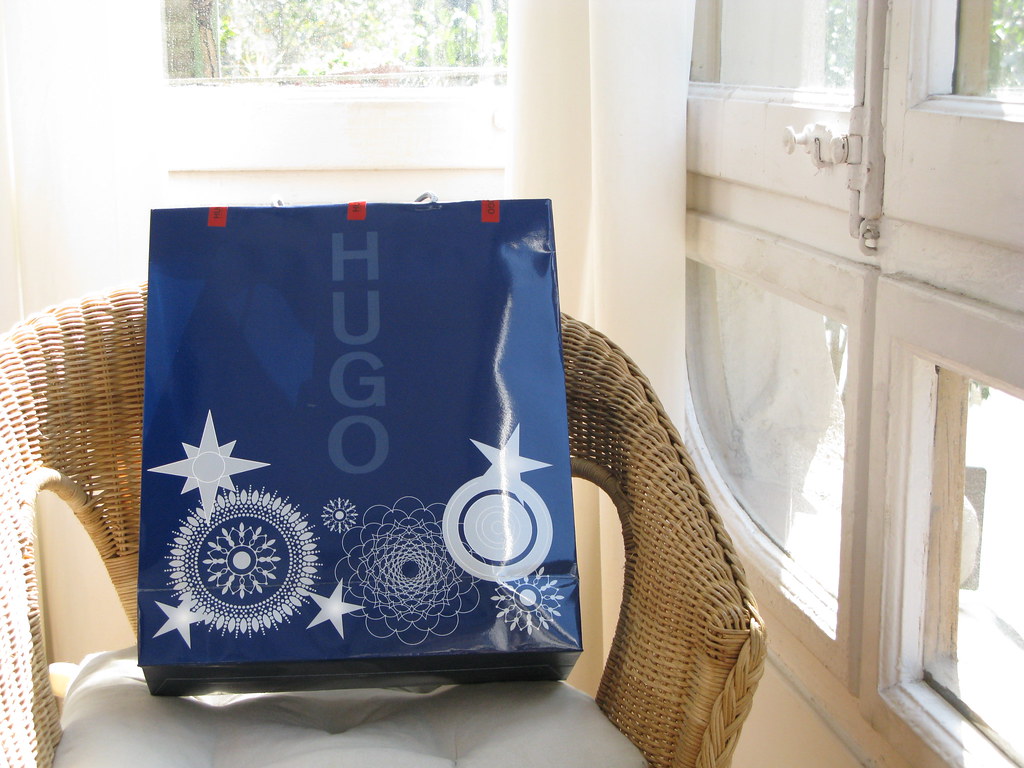
That said, I was unfortunately not carrying a camera at the scene of this post, because I was in Barcelona. This amazing city is unfortunately full of pickpockets, so we thought it best to carry as few valuables as possible. I hope my retrospective shot of the bag will suffice.

---

So we chose Barcelona for our honeymoon. Why? Besides the amazing architecture and gorgeous coastline, we were ready for some shopping. And you can't get more chic than Europe. We actually made a game out of spotting the hipsters, the whole trip looking for men and women that we deemed "tres chic." (I'm aware that this phrase is more French than Spanish, but let's not focus on that).

So we're having lunch in a plaza when we spot two tres chic guys. Dressed alike, they must be employees of some superhip store. We finish our lunch and follow them around the corner, hoping for a totally cultural, uniquely Spanish boutique. What do we find? Hugo Boss.

But this is fine. We're not aware of a Hugo Boss store in Chicago, and even if there was one, this is Hugo Boss Barcelona. Surely it's awesome.

So we walk in. The place is like a fashion museum. Every skirt and blouse is hanging just so. There is one, maybe two of each item, giving the distinct sense that you should only hope you fit into an extra small. There are tres chic salesmen everywhere, in fitted shirts, slim trousers, skinny ties and shiny shoes. I'm suddenly aware that my hair is messy and I'm wearing flip flops.

But I hold my head high and start browsing, taking extreme care not to mess anything up. I pull out a coat and let out a gasp. It's breathtaking. Immediately an employee is there, asking if I'd like to see it. He starts taking it off the hanger, then pulls out the tag. "The cost is 685 Euros." I grimace. Defeated, I say "Okay well...I guess that's out of my price range." He puts the coat back.

I almost give up right then, but decide to keep going. If I left now, I'd seem like even more of a loser. And I might have money! They don't know!

I find some pants with potential and a shirt I like, but the sticker shock has me reeling. (Remember that Euros are almost double dollars these days). So instead, I make my way downstairs, where my husband (eep!) is about to try on pants.

Huh. His salesperson is acting a lot friendlier than mine was. She's showing him the selection, finding his size and making suggestions. And the pants? When he comes out of the dressing room, I have to clap. "Tres chic," I repeat, "tres chic." We decide that this huge bump in quality and fit is worth the price, and that this will be his big-ticket souvenir. We can't afford ten pairs of Hugo Boss Barcelona pants, but we can afford one.

Or maybe two. I start to think it's my turn, so I head upstairs to grab the pants that caught my eye. Now the salesman is suggesting a blouse to try them on with. Okay, well this is a nice change of attitude! When I come out of the dressing room, it's my husband's turn to applaud. The pants are ridiculously flattering. They meet every single one of my pants criteria. Long enough, low enough, tight enough, the right color, the right waist, even the right pockets. These pants were made for me. I felt I had been searching for them all my life.

And then the whirlwind really hit. One saleswoman was handing me the suit jacket that went with the pants. Oh, they are part of a suit? Another was handing me 3-inch heels to complete the outfit. Wow, my legs look amazing! The original salesman was asking if I'd like coffee or water. As I checked out my completely transformed power businesswoman self in the mirror, he was holding out a silver tray with a champagne glass of water. I had gone from an inconvenience to the star of the store.

---

As we stood at the register, me still sipping from my lovely water glass, I was feeling euphoric. Here we were, a power couple. A couple with careers. Careers that needed pants. We were not tacky American tourists. We had money and we meant to spend it. Spend it on...

"Excuse me? The machine is not accepting your card."

My face felt flush as I asked the man to try again. Perhaps something was wrong with the machine. He tried again, then called the service line. As he spoke Spanish into the phone, my husband and I exchanged nervous whispers. "There's nothing wrong with our debit card...right?" "Shouldn't be, I put an international alert on it." "And it's worked fine so far." "Unless this is more than we have in our account..." "Oh yeah..."

The man hung up and proclaimed, "It is not the machine. It is your card. Do you have another card?"

---

As we walked away from Hugo Boss Barcelona, we felt like a couple of clowns. Who did we think we were, millionaires? Sure, we have jobs but we're not the kind of people who can prance into shops and spend hundreds on a whim! No, we were just two Americans, probably broke from paying for a wedding. We felt really, really embarrassed. Like phonies. I just kept asking myself, what happened in there?

Well, I think I know what happened in there. Frustrated because of poor treatment, I'd felt a need to prove my worth. "I'll show them," some part of me probably said. "I'm somebody. I'm worthy of your clothes. I can afford you." And then, out of my defiant overconfidence, an elite club had opened its doors. For a brief moment, we took a peek into the world of wealthy people. And it was thrilling. Special treatment is quite the rush.

But when it sweeps over you, it tends to mask reality. As we walked back to the train, we asked each other the hardest of questions. Could we really have afforded that? Are we really Hugo Boss customers? Was this whole card thing a blessing in disguise? Were the pants just not meant to be? Who do we think we are?

---

Well, as it turns out, our card was fine. We went to an internet cafe and checked our balance. The funding was there. We went home anyway and grabbed a credit card. Then, because I felt that I could not leave Spain without those pants, we went back to the store. The salesman kindly tried our original debit card again, but no dice. Somehow, that card and that machine were just not meant to be.

But our other card worked fine, so we got the pants. What we also got was a reality check. A serious examination of our place in society. We're not broke, but we're not millionaires either. Buying clothing at Hugo Boss was immensely exciting, but we can't do it every day. Maybe someday, we'll have another chance to be treated like rock stars. Maybe someday a regular store will treat everybody like rock stars. But until that day comes, we're back to America and back to reality. Paying off our credit card like everybody else.

1.09.2008

Shopping for The Dress

First of all, before everyone freaks out, no. This is not The Dress. Just the first one I tried on.

---

So as you all know, I've got a wedding to plan. This is a thrilling, emotional, stressful journey in which my money is taken from my wallet in all sorts of new ways.

You see, the wedding industry knows that every bride is secretly irrational. They know that if they push the right buttons, brides will turn to piles of cash before their very eyes. Buttons like, "This is the day you've been dreaming of, ever since you were a little girl!" "Your wedding only happens once!" "It's the happiest day of your life!"

But let me get this straight: It's the happiest day of my life...therefore I should spend $120 per person on dinner? My wedding only happens once...therefore I should pay $6,000 to rent a room? I've been dreaming of this day forever...therefore I should buy $2,000 worth of flowers? Are you people nuts?

These people are not, in fact, nuts. The problem is, they think I am. They think all brides are. And to be honest, many brides ARE nuts. Their standards are raised, their price gauges busted. It's all so expensive, what's another $3,000 for the dress?

Oh, the dress. That marvelous pile of satin and tulle, that giant white cream puff of lace and beads.

That overpriced, overhyped tearjerker that you only wear for ten hours! Of every nuptially-related search that I've gone through so far, shopping for my dress has been by far the most ridiculous. People, if it's been a while since you were married, or if you have yet to go through this crazy time, let me share with you a little transmission from the desperate, manipulative and utterly backwards world of wedding gown shopping.

In order of increasing weirdness:

The appointments. One cannot simply walk into a bridal shop and start trying on dresses. Oh no. One must make an appointment. These relics of the past serve to hammer home the "personal service" point, but man, are they annoying. Mainly because they slow everything down, a la "Our next appointment is two weeks from Tuesday." But also because you walk in, already feeling this big obligation to buy. For that hour, you are the only customer in the store. I don't need any more pressure!

The clamps. Gowns in the store are called "samples," and all samples are a "sample size." If this size is too big for you, which it probably is, stores will clamp the dress together to make it fit. I am not joking when I say that these clamps look like they were recently used to hold the 2x4's on the bandsaw down at Ace Hardware. They are huge and strong, come in all sorts of bridal colors like Home Depot Orange, and are incredibly difficult to squeeze.

Therefore, shop attendants must double as construction workers, complimenting you on your figure, pulling the dress tight, then clamping it tighter with every ounce of strength they've got. The clamps look and feel completely wrong for this environment, which is otherwise all soft and pink and ruffly. Yet every shop I've visited uses them. Could some aspiring wedding entrepreneur please come out with proper dress clips, so stores could stop using this clumsy workaround?

The partial nudity. Dressing rooms in gown stores are HUGE. Plenty of room for your mom, your sister, your friend, your attendant and her assistant. Pretty much the whole store could fit in there, and they sometimes do. But is there another, smaller room for you to get down to your skivvies? Nope. You've got to dress and undress, dress and undress, in front of all those people.

Fortunately for me, I've had a smaller entourage (sometimes even going alone) and been blessed with only one or two employees in my room at a time. But still. If I'd known about all this standing around in a corset and undies, I might have shaved my legs.

The lack of browsing. Wedding stores tout their personal service like they invented it. What this means is that when you arrive, you describe your taste, then THEY choose the dresses you see. It's rare to find a big, open store with racks for browsing. Rather, a woman rushes back and forth from your room to "the back," pulling only dresses that she thinks you will like.

This process may work well in theory (she makes real-time adjustments to her selections based on your reaction to each dress) and has grounding in operations (if customers handled all the dresses, they would get dirty faster) but it still feels really opaque to me. Like I am some rich idiot to be catered to, rather than a consumer with any control over what I see. I often leave thinking, "Man, I only tried 9 dresses and I know she has hundreds back there." How is hiding the product a good way to sell it?

The veil. Right at the end, when you've found a dress that just might be The One, the attendant says, "Oh sweetie, that looks fabulous! Here, let me get you a veil." She slides the comb into your hair, and suddenly your whole head is framed in a halo of white lace.

I must admit, this works a little too well. Even on me, the most skeptical shopper, the most hyper-aware of this type of trickery. Veils are probably Sales Tool Numero Uno at bridal shops, because with a veil on your head, it's no longer dress-up. It's the real deal. It's like HOLY CRAP I AM TOTALLY GETTING MARRIED. It's thrilling and scary and magical. And you know what happens - I just integrate the dress I'm wearing right into that vision. Of course later, when I'm stewing over my options, it's hard to mentally separate the two. So reader, beware the veil and its powers of influence. Keep your focus on the dress.

The lack of information. This is the weirdest of them all. Let's say you've found a dress you like. It fits your style, flatters your figure, makes you feel like a real bride. But let's say your mom isn't there. What might you want to do next? Perhaps get her opinion? How about taking a picture? Many stores say no.

And the reason for it is even weirder. Historically, bridal shops have always had exclusivity agreements with designers. So a particular brand might only be found at one store in all of Illinois. This creates the impression that you can only buy this dress in this store. And stores have ridden the exclusivity wave for years, because a bride in Chicago could only really buy gowns in Chicago.

However, as the internet gains traction as a viable gown resource, the possibility of brides price-comparing and 'buying the same dress somewhere else' becomes even greater. There are discounters and consigners and Craigslist and you can even buy cheap knockoffs from China. So stores are freaked out - after all, they're losing their competitive edge. Their response strategy? Limiting the amount of information that a bride can leave with. If she can't look it up, she can't find it cheaper. Hence, no photos.

But surely you could write down its brand and style name, so you could look it up for future reference? Nope. Many stores literally rip the labels out of sample gowns, so that you cannot even tell which dress you are trying on.

I read about this shocking tactic in a handy book, but found it hard to believe until I experienced it firsthand. I was in a pretty posh store, and I liked a dress by designer Melissa Sweet. But it was pricey, and I wasn't ready to buy. I asked the owner, "Which dress is this again, so I can remember it?" She said, "It's the Melissa Sweet." I said, "I know, but which one? I know they all have style names, or numbers or something." "Nope," she said, looking down at her hands. "That's all you need to know."

Wow! Wow. Well, all I need to know is that I won't be making my purchase here!

---

Of course, all of these elements serve to make me, the bride-to-be, feel completely helpless. I can't walk in off the street, can't feel comfortable in the dressing room, can't browse a wide selection or pick my samples, can't take pictures, and sometimes, can't even know what I'm trying on. It's retail manipulation at its worst, and I'm getting pretty tired of playing the game.

Now of course, I want a beautiful dress. I want a dress that is as unique as I am. I want a dress that will make my boyfriend cry, that will make the whole room gasp, and that will still look awesome in photos 50 years from now. This is no small request! Therefore, this is already no easy shopping trip.

But I also think that finding the dress is intricately tied to the retail experience surrounding it. I haven't found my dress yet, and I think it might be because I haven't found my store yet. Sure, I am looking for an ivory gown with a mermaid cut, lightweight material, tasteful ruffles, no beads, no sparkles, no lace, and some type of sash or bow. But I am also looking for a low-pressure environment with friendly, honest, forthcoming employees, lots of choice, and the ability to deliberate in private. Oh, and no veils until I say so.

Wish me luck.

10.07.2007

Show a little care

Ladies and gentlemen, today we're going to talk about etiquette. Retail etiquette.

To help you understand the early roots of my interest in this topic, I'd like to start with a song from my childhood. It's by Carol Johnson, a singer who heavily influenced my musical upbringing. I listened to this song from the tape deck of my Chevy Astro van, while my mom drove me to and from gymnastics. And in those formative years, long before the advent of Retail Planning, one song forever altered my perspective on proper in-store behavior. The song was called "Show A Little Care."

(Yes, I still remember the words, twenty years later).

---

Mrs. Jones hangs up the clothes, in the store where she works each day
Folds and stacks, and straightens the racks, arranging a nice display
But those messy shoppers, they get so sloppy, they leave things in a heap -
And a tangled mess, is all that's left, of the work she did so neat.

Would you do a thing like that? No way!
Now who would do a thing like that? No, no, no, not me!
Show a little care for the people out there, who care for you and me.

---

Oh, that poor, dear Mrs. Jones. My heart went out to her. And as the song clearly stated, I was taught from an early age to not "do a thing like that." I wouldn't be a messy shopper. No way! It was burned in my brain.

But is helping out, really helping out? You be the judge. Test your retail etiquette with this fun quiz.

Question 1:
You're in a clothing store. Sweaters are folded neatly on a table. You start looking for your size. You unfold a medium, then a small. The small looks right, so you decide to take it. Quick: what do you do with the medium?


a) Fold it back up as neatly as you can
b) Leave it unfolded
c) Hide it behind a plant

In this scenario, I tend to go with "a." When I unfold something and decide not to pursue it further, I make my best attempt to recreate the corporate-issued, store-perfect folding protocol. But I fail. I fail every time. I wasn't trained! I don't know the sleeve trick! Try as I might, I simply cannot make the sweater look like all the rest. So am I really helping?

My guess is, I'm not. I feel like the correct answer here is "b." The employees are going to have to re-fold it anyway. Still I wonder, do they appreciate my attempt? Do they come over later and say "Aww, this customer really tried!" Or was my childhood direction misguided? Grounded in an ideal reality that would never come to pass? I want to help Mrs. Jones. I just don't know if I can.

Question 2:
Now you're ready to try on some clothes. A salesperson shows you to a fitting room. You try things on, you shuffle hangers, you toss things in the "yes" pile and the "maybe" pile. You finally decide to buy one thing, and leave the other six. Quick: what do you do with the unwanted items?


a) You hang them up, and bring them around the store, putting them back where they belong
b) You hang them up, and bring them to a reject rack just outside the room
c) You leave with the shirt you are buying. The salesperson can deal with it.*

*It's her job, right?

I face this dilemma on a regular basis, and I must admit, I'm not consistent with my choices. On very rare occasions, when the store and staff are nice, I will actually go with "a," because I actually feel like helping. Typically, though, I'll go with "b" if said rack exists. But if I'm tired, or if the staff aren't around, or if the store's already a mess, I'll just walk out. Sorry, Mrs. Jones. Maybe if your dressing rooms were neater or you were nicer, I'd feel more of an obligation.

Question 3a:
Now you're in the grocery store. You pick up a bottle of ketchup, put it in your cart, and continue shopping. Halfway through the store, you remember that you bought ketchup last time, and you totally don't need more. You are now in the paper towel aisle. Quick: what do you do with the ketchup?

a) Bring it back to the ketchup aisle
b) Leave it in your cart
c) Stick it on a shelf next to some Brawny

Come on, people. You know you go with "c." At least, I do.

Question 3b:
What if the item had to be refrigerated? Like cheese, or yogurt?

Question 3c:
What if you were in Whole Foods?

Basically, I think the question "How polite are your shoppers?" can be easily answered with "Well, how polite are your employees?" Because it's not like I'm univerally kind, or universally careless. I mean, I re-fold sweaters in J. Crew, but I also leave ketchup in Aisle 9. This is partly because the staff at J. Crew give me smiles, and the staff at Jewel give me blank looks. People, respect is a two-way street. I would not hide the ketchup at Whole Foods.

I'd like to think Mrs. Jones is retired by now. Maybe her little boutique lives on, run by her daughter. Or maybe The Gap moved in next door and put her out of business. Either way, I'm glad she showed a little care. If stores would show me a little care, I'd gladly return the favor.

9.24.2007

You've lost me

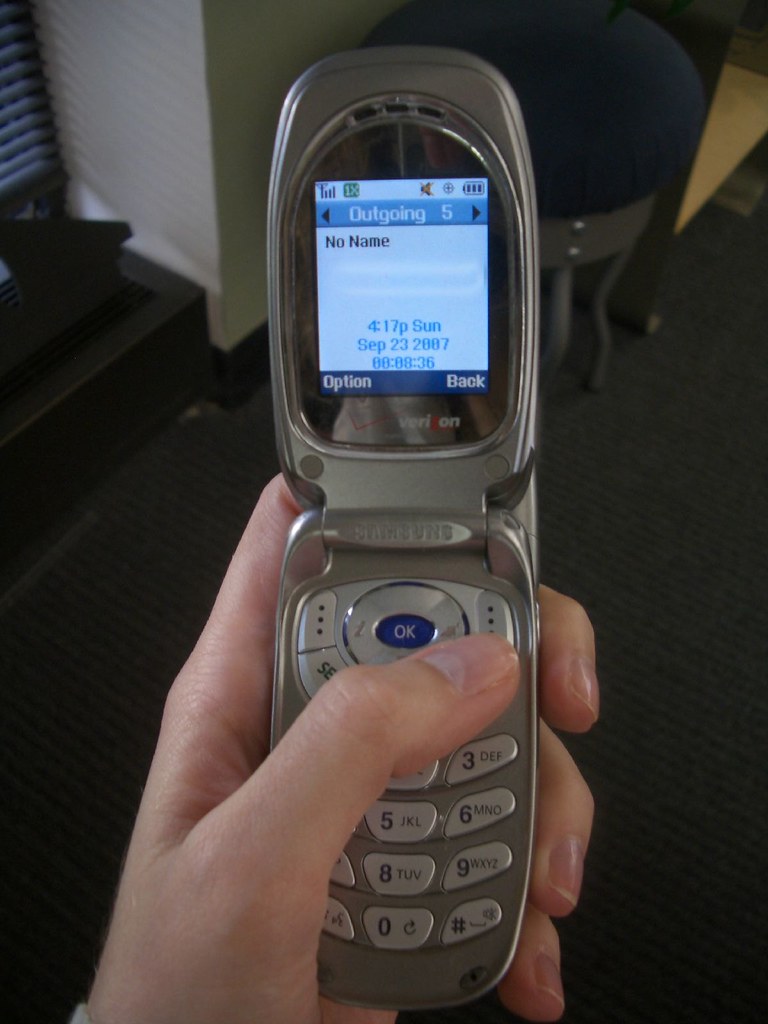
So here's the scenario. You call up a fabric store, curious if they have a particular brand of quilting ruler. (The reason why you need a quilting ruler in the first place is, um, outside the scope of this post). A kindly-sounding woman answers the phone. She has to go and check, and she graciously asks if you can be placed on hold. You agree. No problem.

Time passes. During this time, you experience profound psychological shifts. The very essence of your humanity is called into question. Here is the progression of your thoughts:

00:21 That woman sounded so nice. I'll bet she has adorable grandchildren.

00:59 She must be walking past the wrapping paper, the ribbon, the fabric, the yarn, and the scissors! I hope all this walking doesn't hurt her kind, old feet.

01:37 This hold music is boring.

01:59 She's definitely looking through the rulers right now.

02:42 Maybe she's looking for the head of the ruler department, and he is on the other side of the store. I bet she's paging that guy right now.

03:15 Maybe the head of the ruler department is outside, taking a smoke break. I bet that guy's a total jerk. I bet he and my lady get in workplace disagreements all the time.

04:15 Man, I've been on hold a long time. It's been at least ten minutes!

04:54 Oh my god, where is this woman? Is she just taking her sweet ass time? Does she not have the capacity to walk more than 10 feet an hour?

05:33 Why does Jo-Ann Fabrics hire idiots? Maybe they have some affirmative action policy for slow, stupid people.

06:17 That woman is probably taking HER smoke break! I bet she forgot all about me! Or she thought I wouldn't wait - that's it! She probably thought to herself, "Well, it's been so long now, that chick on the phone MUST have hung up by now." God, I feel stupid for ever trusting a word she said.

06:48 Oh jeez, I hope she hasn't fallen under a ream of chenille and broken her hip! Then I'd feel terrible! I'm such a mean, impatient person. Okay. I can wait. Breathe in, breathe out.

07:26 All right, that's it. I don't care anymore. I don't care if she's still looking, if she's stopped looking, or if she's trapped under a mountain of rulers and is eating her own arm off. I have waited on hold for what feels like twenty minutes. I want out. I'm hanging up.

07:29 No wait, I can't do it. What if she's just about to pick up the phone? What if she's been looking high and low, searching through dusty catalogs and moldy storage basements, and she's got the ruler in hand? And she's worked SO HARD to find this for me, and she comes back, and she hears a dial tone? She'll kill herself! I can't do that to another human being! I'll wait.

07:45 But seriously, how long does it take? I mean, how big is the store? How many rulers must she look through? And I'm using cellphone minutes, people! I'm not one of those thousand-minute-per-month schmos, either! I'm talking 450! Every minute is precious! You are messing with my currency! Jo-Ann, you are robbing me point-blank - and I'm letting you do it! That's it, I'm hanging up.

07:51 Oh god, so help me but I can't do it. I just can't do it. She could be inches away. She could be scarred and bleeding, the paramedics pushing her bed on wheels, sirens blaring, ten firemen clearing the path from the accident site to the phone, and she's yelling "The ruler! I've got the ruler!" I can't let her die, mission unaccomplished!

08:12 Pick up the phone...NOW. Okay, NOW. Come on, lady. Get back to the phone...NOW.

08:25 Oh my god oh my god oh my god! What to do what to do what to do? Finger is trembling over the "End" button.

08:35 Please don't let my karma be forever ruined!

08:36 Beep.


Employee at Jo-Ann Fabrics, I'm sorry. You lost me. I had all the best intentions, but I no longer care about the ruler. I'm sure you have adorable grandchildren.

7.16.2007

Self-checkout for dummies

Oh, the self-checkout. That glorious innovation of the retail world. The unbridled freedom it brings to the quick-trip shopper. The confidence it inspires in its self-empowered users.

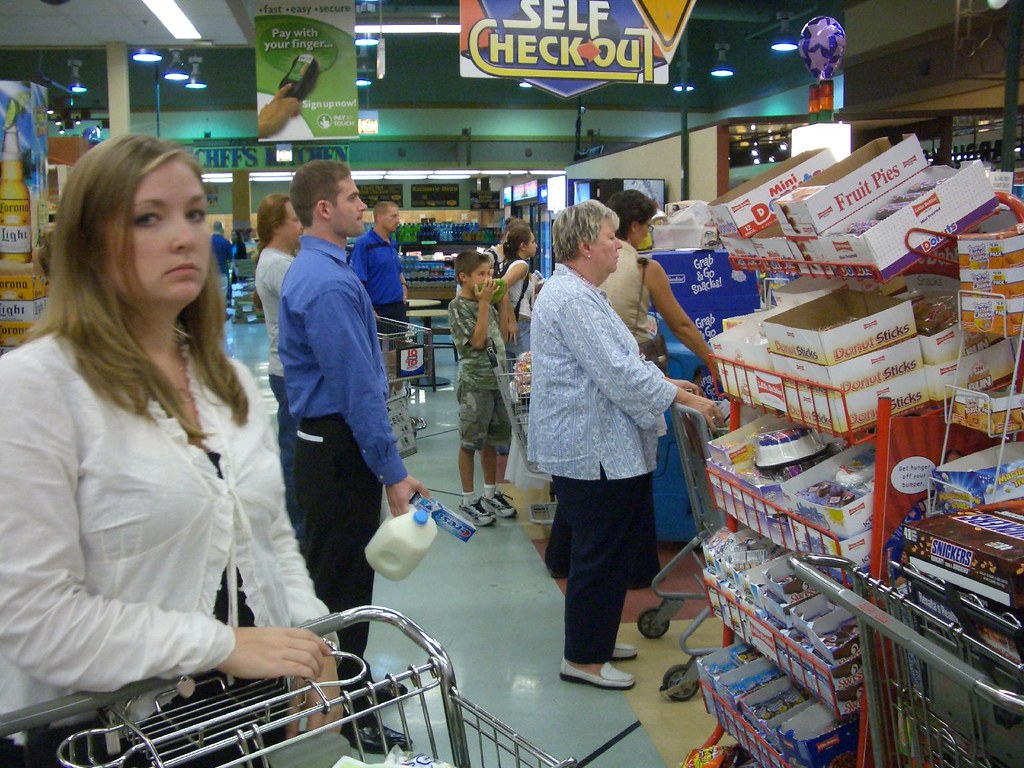
The Lord of the Flies is what it really is. There's a long line and no authority and suddenly, everybody wants to kill someone. I'd love to jump up and take control: You - over there! What's your problem? Get your debit card facing the right way! Load your groceries! There's an unexpected item in the bagging area! Get to it, man!

In reality, though, we all just kinda stand there, annoyed. The rules aren't posted, aren't enforced, and aren't even clear in the first place.


A few weeks ago, on the third of July, my local Jewel was hopping with youngsters buying beer and snacks for the holiday. Each person had been planning to run in, buy four things, and run out. But the line for the self-checkout was at least twelve people long.

Fortunately, the store's not stupid. They anticipated the rush. What did they do?

They brought in This Guy.


This guy might be the store owner, or some unfortunate soul from corporate. But thank god for him, because he enforced the rules. Rules that I forgot existed! I delighted in watching him stop people who were trying to cut the line, and helping shoppers who couldn't figure out why the machine was so mad at them.

It got me thinking. This guy is fabulous. He's making order from chaos. But he's not going to be here tomorrow. And the problems still are. The self-checkout may be helping the store process customers and save money, but it's got plenty of issues. And I believe these issues stem from a lack of clarity on the rules.


So in an effort to help you, me and everyone we know, here are my 5 rules of the self-checkout.

1. There Is A Line. How many times are you waiting in line, and some guy walks right up to a machine? Just cuts in front of all the patient folks? Buddy, there are no frontsies, no backsies, no cuts. There is a line, and it's your duty to find it. Oh, and there isn't a different line for each machine, either - there is one line for all of them. So wait your turn.

2. Pay Attention. How many times does some woman get to the front, receive a cellphone call, and totally tune out? When you are in line, and especially when you're first, you need to be scanning like a hawk. I want to see eagle eyes. When twelve angry shoppers are behind you, do not take your eye off the ball. For god's sake, do not answer your cellphone. Give the process some respect.

3. That Machine's Not Broken. This is classic crowd behavior. Nobody's using that machine, so it must be broken. Nobody continues to use that machine. It's like in the bathroom stalls, when nobody checks for feet - they just assume that one is unavailable because the door is closed. Why don't you try the machine, then tell us if it's broken? Don't worry, we won't let you lose your place in line.

4. Ten Items Or Less. Seriously. Don't bring your cart with a hundred dollars worth of kitty litter and tuna fish and expect to do the whole thing yourself. This line may move faster because there are 8 kiosks, but you are six hundred times slower than the lady at the register. If you need all that stuff, let the cashier do it. She is faster because unlike you, she is being paid for this.

5. The Bar Code Is Somewhere Else. Some people just cannot get a grip on the mechanism of the self-checkout. They're scanning and scanning, trying to get it to pick up their pineapple. Okay. Your pineapple has one sticker on its entire body. It's on the top. Stop scanning the bottom! Turn it! Flip it! Try something new! And people, you know who you are.

Now, I am making these rules up based simply on my own experiences. These rules were never shared, with me or anyone else. There was no training. No pamphlet. No Self-Checkout For Dummies. I mean, cashiers know what they're supposed to do. If their register freezes, they don't just stand there gazing into space. They get on the horn and fix it.

But shoppers are not cashiers. And as much as the store would love us to behave like free labor, we aren't going to do that because we don't know how. So stores, if you want your shoppers to behave like employees, then train us like employees, and post the rules. Your rules. Just tell us what you want us to do. We could use a little direction.

5.08.2007

Thinking outside the vestibule

Disclaimer: this story happened about two years ago.

Disclaimer to the disclaimer: it's still pretty insane.

---

So in the city of Chicago, you don't really need a car. Depending on where you work, it is often quite feasible to commute using public transportation. In the spring of 2005, I was finishing up grad school and planning for my new life which included, among other things, finally buying a car.

But on this particular day in April, I did not have a car. What I had was a check, a check that desperately needed depositing. I was low on funds, and I'd made a regrettable transaction that would put my account in the red within 24 hours. Plus, I was going out of town the next day. So basically, it was now or never. But I wasn't worried. I walked out of my house and down the street, to my local LaSalle Bank.

I've been a customer of LaSalle Bank for almost ten years. I think I joined out of necessity; they were the prescribed bank of choice for Northwestern students when I was a freshman. But I'm fine with this. In their many years of service, I have found LaSalle to be convenient, consistent and pleasant. Hardly a blip on the radar.


So it's Friday, and it's 6:30. The branch closed at 6. Shoot. I walk around the side, and the drive-thru is open until 7. Sweet. The outdoor ATM is obviously open too, so I try that first. But this particular ATM decides to be "not accepting deposits at this time." Shoot.

Still, it's no problem. The drive-thru teller's window is open for another half an hour. So I wait for a car to drive away, and then I walk up to the window. There's a man sitting behind the glass. I give him a smile. Then, because I think I'm a pretty funny girl, I make a gesture like I'm resting one hand on the steering wheel.


He doesn't smile. I use the other hand to gesture "honk honk" on my imaginary horn.


Nothing. Confused, I tap the glass.

"I'm sorry ma'am, but this window is for customers in cars."

He's obviously joking, so I laugh and shake my head. "Oh, right! Heh heh! Yes. Good one. Now I really need to deposit this check."

"Ma'am, I'm very sorry. But I can't perform that transaction. This window is only for customers in cars."

The city noises fade to silence in the background. All I hear is the echo of his words: "Customers in cars...cars...cars..."

"Wait, you're serious? But your lobby is closed! The ATM is broken! Sir, I need to deposit this check. My account is going to go under. Can't you just take it? Please?"

"I'm sorry, ma'am."

Wow. I'm dumbfounded. I slowly take a couple steps, then stop. Then look back. My confusion turns to anger. Customers in cars? That doesn't make an ounce of sense! Here I am, a loyal customer for eight years, and because I'm not seated behind the wheel of a paycheck-eating, gas-drinking, life-endangering and wholly unnecessary motor vehicle, he won't serve me? What could possibly be the reason for this?

Is it safety? Will I get run over by the car behind me? Or is it validation? By having a car, am I somehow proving myself to be a worthy LaSalle Bank customer? Or is it just a policy? A policy that sounded good in the positive - "Our drive-up is for customers in cars" - and was now being interpreted by its corollary negative - "Our drive-up is NOT for customers NOT in cars."

Whatever the reason, I was pissed. I turned to face the traffic going by. And then, I had an idea.


It took me about seven seconds to hail a cab. I leaned in and told the driver to turn around, that we were going through the LaSalle Bank drive-thru. The cabbie was confused, so I quickly explained what had just gone down.

"THAT IS BULLS--T!" he roared in a thick accent. This dude got mad so fast, I barely had time to slam the door before he stepped on the gas. Perhaps he was someone who had experienced this kind of inept corporate bureaucracy himself. Either way, he was on my side. We squealed around and pulled up into the teller lane.

The cabbie rolled forward until my window was lined up with the bank's window. There was a split second of awkwardness, and I asked him to please roll down my window. Then I saw the teller's face, saw it change from confused to embarassed.

"Hello! Hi there!" I waved with a big obnoxious grin. "Here I am! In a car! I'm a customer, and I'm in a car! Just like you said! NOW PLEASE TAKE MY CHECK."

And you know what? He did. After a moment's hesitation, he opened the slot and, through the backseat window of a Chicago Checker cab, I handed him the envelope.

---

Customer service is a balancing act. For most companies who have retail locations, spread out across a region or country or planet, headquarters has to decide what to control, and what to let go. Depending on the company, one of two strategies tends to emerge.

Some companies empower their employees, viewing them as an asset. They decentralize decision-making and equip their workers with the tools to make good choices. These companies trust their store managers to display products the right way in each local market. They trust their salespeople to say the right thing, without enforcing a script. They provide employees with tips and frameworks, but leave enough room for interpretation that former drones turn into humans.

Other companies control their employees, viewing them as a liability. They standardize operations and issue strict guidelines. One small improvement can save millions of dollars, while one small mistake can cost even more. These companies provide machinery so advanced, it can cook a burger with zero opportunity for error. They send their drivers on step-by-step routes that minimize the use of left turns. They limit their workers' accountability, preferring to keep them on tighter leashes. They might make fewer mistakes, but they also make fewer great impressions. Plus, their workers are inevitably reduced. Humans fade away, and drones emerge.

Of course, different employees in different areas of a company will have more or less autonomy - depending on things like experience, customer interaction and the task at hand. I'm guessing that someone making fries at Mickey D's does not have permission to say, "I think I'll try adding cinnamon!" Whereas someone managing the same restaurant is empowered to grant the customer a refund, if the fries were sprinkled with nutmeg.

But there is an obvious contrast in the level of empowerment between comparable employees at different companies. You can just sense it. How much "the rules" matter becomes evident when you are redeeming just-expired gift cards, for example, or when you have to show two forms of ID and you only have one. Basically, the rules only matter when they are being questioned. And whether or not the employee is "allowed" to break the rules often makes the big difference in the do-or-die issue of customer loyalty.

Ultimately, I believe it comes down to a fundamental trust in people. And hey, I'm not saying every company has to trust all its employees. Not every stock boy is the sharpest tool in the hardware department. But employee empowerment is a self-fulfilling prophecy. If you limit people, they will behave with a limited outlook. They'll blindly follow rules because they weren't trained to think otherwise. But if you trust people, and empower them with training, they will see the rules from the viewpoint of the customer. Empathetic employees - isn't that what everyone wants?

---

It was recently announced that LaSalle Bank is being sold to Bank of America. A new company will come in, change the rules and present its own philosophies on customer service. Maybe they'll have trusted, autonomous employees. Maybe they'll have some wonky policies of their own. I only hope that if one day, I walk up to a drive-thru, they'll take my deposit.

1.29.2007

It's my life; it's her job

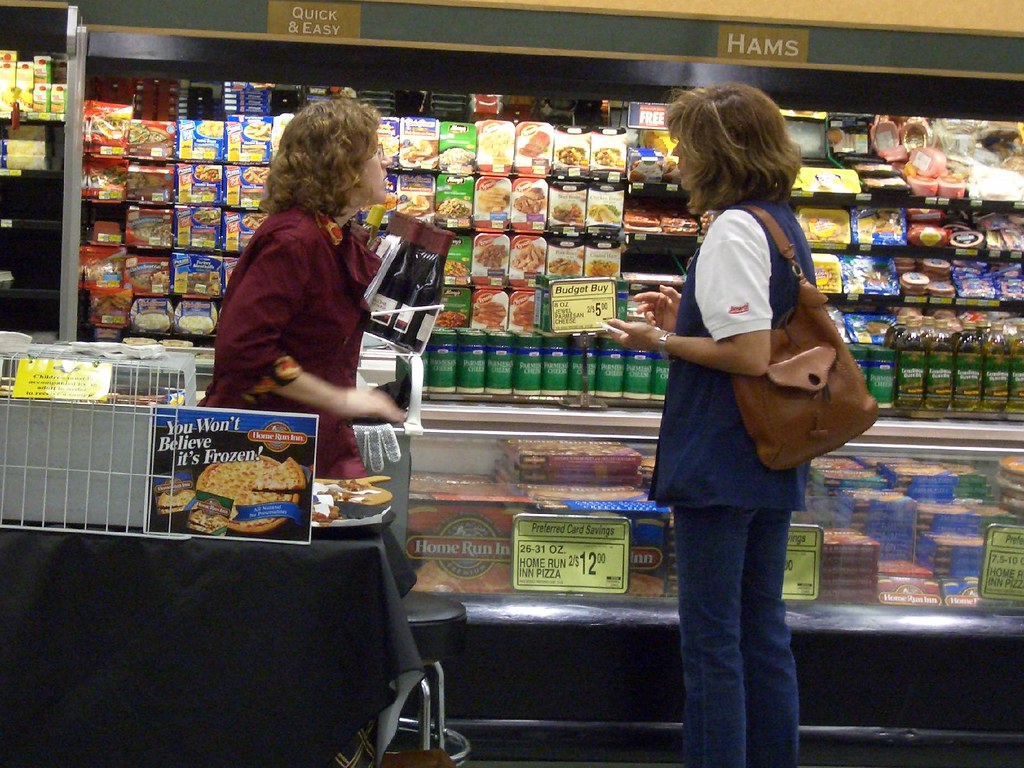
So I'm shopping for groceries, one Monday night at Jewel, when a woman's voice stops me in my tracks. "Would you like to try some fresh hot pizza?" I don't have to think; of course I want to try some fresh hot pizza. As I stood there chewing my tasty sample, I slowly realized that it was unlike other frozen pizzas. So surprisingly delicious, so crisp yet doughy, so sweet yet cheesy, that I started to feel a strange love for this woman.

The pizza was from Home Run Inn, a local Chicago company. And it was good. Really good. But why did I transfer my product-love into person-love? Did this woman own Home Run Inn? Of course not. Did she even work for them? No, she worked for Jewel. Perhaps she made this pizza? Heated it up in her own oven? Rolled the dough with her own two hands? No, she was simply doing her job. She had no connection with the product, none whatsoever, and yet I felt like it was she alone who had brought me one step closer to heaven.

---

This is my theory, and it may sound strange, but here you go. I care more about employees than they care about me, because when we interact in a store, it's my life, but it's their job.

When we talk with employees in a store, we care about them. At least a little. Because whatever is happening in a store is happening "in our life." Shopping is a chore, a leisure activity, a form of entertainment or a contribution to the family, but it's an event that takes place during our everyday lives.

But for store employees, interactions with shoppers are a dime a dozen. Each person asking them a question is just one more distraction, one less item stocked, one less customer checked out. People may blip the radar if they are especially annoying, funny or strange, but for the most part, shoppers come and go and the radar just stays flat.

Yet for better or worse, we endow store employees with an unrequited amount of importance. We want to give them credit when their products are great. More often, we don't want to hurt their feelings when their products are bad. Worst of all, we feel embarassed when they see us buying something awkward. But do these people really care? Of course not. This is just their job.

Example 1: The pizza lady. I loved her product, and so I actually wanted her to see me buying it. I discussed my purchase with her. I picked up the pizza very blatantly, and made sure she saw me putting it in my cart. I wanted her to know my true feelings for "her" pizza. But was she proud? Pleased that her salesmanship helped Home Run Inn? Probably not. I mean, she's just doing her job.


Example 2: The wine lady. She handed me a friendly sample of some sparkling wine. I hated it. It wasn't sweet like she said it would be. It was dry and it burned in my throat. But could I hand the tiny cup back to her, half-drunk and choking? Of course not. I thought this would hurt her feelings. So I carried it three aisles away and tucked it behind some peanut butter. Would she have cared? Probably not in the slightest. It wasn't personal.

Example 3: Something we can all relate to. The cashier, at any store where embarassing-yet-necessary products are sold. I'm talking about family planning products, feminine hygiene products, medicine for strange and unattractive conditions. It's bad enough that we have to ask someone to get them out of the locked case for us. Then, standing in line, we pray that the checkout lady doesn't roll her eyes, snicker, or make some awkward comment. But does she ever? Does she really care about the size of condoms we are buying? Or the fact that our new tongue scraper is recommended for bad breath? Of course not. She's just trying to get through her shift.

Now I'm not saying store employees aren't important. They are people going about their jobs, and tough jobs, I might add. Some might care a lot what their customers think, or giggle once we're out the door. But as shoppers going about our lives, we like to think that we are unique to them - that our tasting and purchasing experiences are original and that we must affect them oh so much. On the contrary, the people who work at the grocery store have probably seen it all. They've had shoppers who loved their samples, and shoppers who hated them. They've encountered nice people, rude people, annoying people and crazy people. They've seen nine customers this week buying hemorrhoid cream.

So maybe I think my in-store interactions are important because they are a chapter in my day, a break from the norm, a story to tell friends later. Perhaps I only talk to one employee, so that person becomes memorable to me. But for the employee, it would take a lot to truly rock her boat. She sees hundreds of me an hour. So the same interaction that has so much importance to me, has almost none to her. Why? It's my life; it's her job.

12.13.2006

Lessons from the other side

Last weekend, my boyfriend and I exhibited t-shirts at the Renegade Craft Fair. Renegade is your typical urban retail gathering. It's a large group of funky, clever crafters who range from very amateur to quite professional. We are not quitting our day jobs any time soon, but we sold shirts and made connections and boosted our brand awareness. It was a good two days.

For me, Renegade was especially interesting because as a shopper, I often wonder, "My god, what is this store thinking?" Now, in an unexpected turn of events, I had become the store. So here's what I was thinking.


Lesson 1: Don't stare at shoppers. Don't even look at them. Forget what you know about manners. Don't smile at anyone. It only freaks them out. Don't even make eye contact. At all. Resist the urge to watch the endless parade of fascinating people walking by your booth.

I noticed that when I would look at someone, the minute they saw me looking, they'd start backing away. Politeness is generally a good thing, but as a shopper, intense scrutiny (or even a casual glance) can be a huge buzzkill. I know that when I enter a boutique and I'm the only shopper, and the woman at the counter greets me in a warm and cheery way, I want to get the hell outta there. This effect is magnified in a small, intimate ten-by-six space. So I quickly learned to stop looking, stop smiling and stop freaking people out.


Lesson 2: Look busy. If you are not busy, become busy. Let your "work" consume you. Don't even look up when people approach, until you've given them at least ten seconds to become comfortable in your space. If you are busy, my theory goes, you don't need them. If they want your attention, they're going to have to work for it. It's like a new relationship. You've gotta play hard to get.

I noticed that when I would take up a meaningless task, like refolding all the shirts or reorganizing them into size order, more shoppers would walk up and start browsing. They'd feel more comfortable with that initial approach because they were entering a neutral zone. I wasn't watching over my territory, I wasn't handing them a business card or asking them what size they needed. I wasn't putting on any pressure, and they responded well to my aloofness. Counterintuitive, perhaps. But it worked.


Lesson 3: Fill the space with people. Nothing draws a crowd like a crowd. If your booth has no shoppers, and the booths around you do, people will quickly deduce that your booth has nothing going on. Especially in a transparent environment like a craft fair, with no storefronts or walls to disguise your relative crowdedness, you simply must have people around.

And friends will do just fine. During times when friends were visiting, they would stand right in front of our booth. Were they blocking the merchandise from public view? Sure they were. Was that okay? You bet. Even you yourself are better standing in front of your booth, than sitting behind it. There were times when my boyfriend would sit in the chair, and I would stand in front, just talking to him! And people would come.

The busiest times, of course, would begin when one person decided to make a purchase. As she made her way down the decision tree (size, color, graphics) other shoppers would gather. And if that first purchaser looked like a cool chick, you better believe that helped sales too.

---

Renegade taught me a lot about the subconscious elements of store choice. We notice scrutiny. We notice employee neediness. We notice other shoppers in a big way. So forget everything your mother taught you about manners. The best way to sell product is to ignore shoppers, look cool, and hang out with your friends.

12.01.2006

We hate to wait

Of all the activities that we humans encounter during our lives, which activity do we like the least? Well, there's paying taxes, and there's getting punched, and there's public speaking...but I think there's something worse.

We hate to wait. Oh, how we hate to wait. Just hurry it up! Come on, people! Why is everyone in front of me so slow? The fact is, our time is increasingly precious to us. Waiting is seen more as a waste of time than a necessary evil, and as peoples' expectations for convenience continue to rise, any act of waiting, big or small, becomes despicable.

And waiting causes disproportionate amounts of stress in our lives. Why is it disproportionate? Because, well, the literal act of waiting is so easy. All you do is stand there! It's not difficult, and it's not embarassing, and it's not painful. But my god, does it get our blood boiling.

The strangest thing about waiting is that it tends to distort reality. You may have been standing there for three minutes and feel certain that ten have gone by. If time flies when you're having fun, time sure drags when you're waiting. So retailers talk about "perceived wait time" rather than actual wait time, because frankly, the former is much more important.

You would think we might adapt, find ways mitigate our stress. Perhaps we could just stand patiently while the cashier tries to do a price check and nobody in pharmacy is answering the phone. Or we could sit calmly while other patrons come and go, the time of our actual appointment creeping farther into the past. We could pass the time with a cellphone call, but our fellows-in-waiting wouldn't like it. We could be productive, we could be entertained, we could be learning, we could be socializing. We could be shopping! But usually, we're just fuming. Can anyone take us out of our misery?

---

A few companies are trying. Their strategies are all interesting, if not entirely successful. I'd like to highlight three.


exhale is a posh spa in a prosperous neighborhood. Situated in Chicago's Gold Coast, it caters to clientele who just might think their time is more precious than the time of others. People who tote small dogs and get massages twice a week. People who surely don't have time to wait.

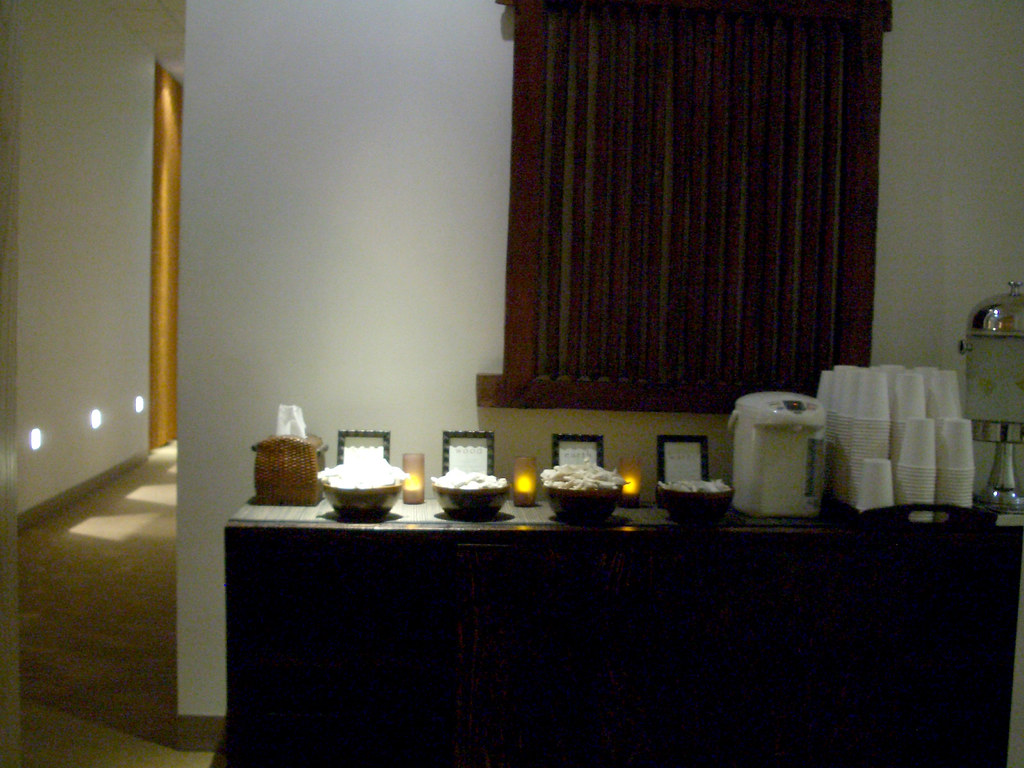
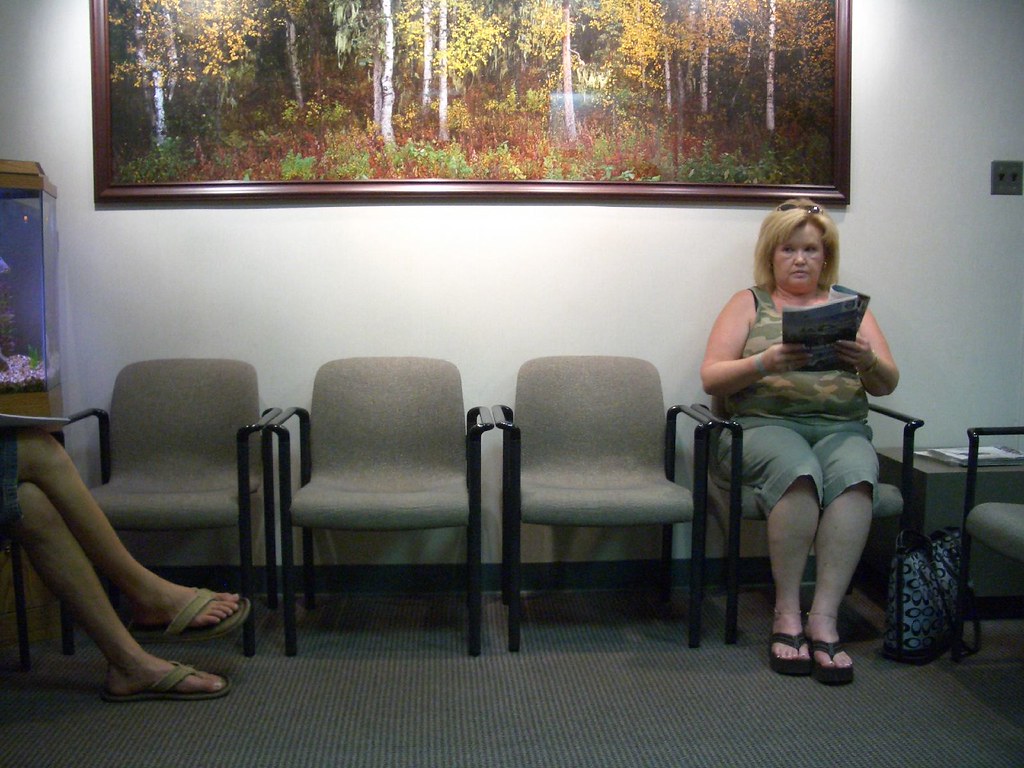
But exhale's waiting area quickly changes that mindset. I was taken to a small, dimly lit space with four kinds of tea, a low-hanging chandelier and a long, padded bench seat. A wood-framed sign asked if I wanted a heated neck pillow. You bet I wanted a heated neck pillow. I closed my eyes, leaned my head back, and almost fell asleep.

This waiting room was so tranquil, and such a change of pace from the outside world, I actually wanted to wait. I could have sat there for hours. In five minutes I think I reached a partially meditative state. While I know this type of experience doesn't work for every business, some of the principles are good. Find ways to slow the customer down, add multiple sensory elements, remove any reminders of time, and create a diversion so pleasant that the waiting becomes a solution unto itself, rather than the problem.


The second example is less about creating the positive, and more about mitigating the negative. But I find it equally illustrative. My dermatologist is named Dr. Michael Greenberg. His waiting room is super generic - chairs in a square, family magazines and a fish tank. But as I signed in for my appointment, I noticed a little pamphlet. It was called "Why Am I Waiting?"

Dr. Greenberg is a writer when he's not a doctor, and he has kindly put together a thorough and heartfelt answer to this question. Written in the first person, it contains passages like these:

If I knew exactly what was going to happen at each patient visit, I could book an exact time slot like dentists do. But many appointments are to find out what a patient's problem is. Once I have a diagnosis, treatment time varies.


What, for example, should I do with an elderly patient who has a skin cancer that needs removal, whose only transportation is a relative who had to take time off work? Should I ask them to return to do the removal? Or should I do the procedure and risk falling behind schedule? How would you want your relative treated?

Dr. Greenberg cites emergencies, no-shows, interruptions, overbooking, and treating the patient, not just their disease, as reasons why I am waiting. After reading this pamphlet - a nice way to pass the time, I might add - I felt a newfound appreciation for his dedication, his honesty, his sense of fairness. I even felt a new solidarity with my fellow patients, as if by my own act of waiting, I was helping someone less fortunate get better care. Again, not all businesses have satisfying reasons "why I am waiting," but most could benefit from a degree of explanation. So try simply telling the customer why, and they might just become empathetic. If anything, they'll realize that your problems are worse than theirs.

The final example is equal parts innovative and evil, and I relate it here as a case of good waiting gone bad. My boyfriend recently visited CarMax. We were selling our Golf, and while friends warned us against the place, we just wanted a baseline quote. The quote was indeed terrible, but the worst part for George was the waiting. He described it like this: "I sat down with a salesman, we discussed the Golf, and then someone went to inspect it. I got up to find the waiting room, but realized that there was none! There was nothing to do but sit back down at the salesman's cubicle. For half an hour, I was subjected to his progressively persistent attempts to sell me a used car. Why their cars were a great deal, some cars I might want to consider, the fabulous CarMax warranty, and on and on."

This is nuts. I find it ridiculous to quarantine the customer, giving them no other option but to listen to your employee try to close a deal. George said he was obviously not interested, yet he was subjected to the same treatment as a willing buyer.

While I understand that CarMax is in the business of selling cars, their strategy of selling cars to anyone, even people who clearly aren't buying, is absurd. But perhaps classifying their customers would help. Letting the waiting experience be dictated by their interest. CarMax has people buying cars, and people selling cars. They could take the buyers to one side of the room, where Joe Hardsell can get right to the point. They could take the sellers to the other side of the room, where Jim Softsell can add value in other ways.

Mr. Softsell could chat openly with my boyfriend about the cars he was considering. He could give him some personal car-buying advice. He could offer him car magazines. He could let him sit in some newer models. He could take him out for a test drive! Or he could help him pass the time by turning on the TV, letting him play video games, or simply giving him the privacy to make a phone call.

CarMax has the resources to give both kinds of people a positive waiting experience. They already have the customer in a given space for a good chunk of time, and they have already allocated a full-time staffer to babysitting him. They need to find ways to make that experience positive, no matter who's doing the waiting. And in general, I wonder if it makes sense for businesses to have multiple levels of waiting. We've already got the self-checkout, the 10 items or less, and the full-cart lines. Some hospitals have different types of waiting rooms. Think about it: are you only making one type of customer wait? Or are there two or more types, with very different needs?

Whether you need to boost a positive waiting experience, lessen a negative one, or create multiple levels, please remember that waiting is an important and often overlooked part of the retail experience. The bar is currently set so low that any attempts to improve should be disproportionately appreciated.

9.15.2006

Disappointment of the day


A few weeks ago, I stayed in a Holiday Inn Express. It was typical business travel - a rather uneventful 3-hour drive, followed by a routine check-in at a generic hotel. As I handed the woman my credit card, I turned and noticed a big dry-erase board on the counter.

Handwritten in an array of bright colors, the board welcomed "Gary Galleher, our Guest of the Day!" Huh, I thought, that's kinda cool. Upon questioning, the front desk attendant told us that indeed, Gary had already checked in, and that yes, he had been excited. "They always get excited. They all get out their cellphones and take a picture." How sweet. But what does Gary get?

It turns out that Gary gets a pretty good deal. Besides seeing his name in marker, he gets an upgraded room, which I believe contains a jacuzzi tub, and a free movie rental. Oooh. The room, the tub AND the movie. I felt genuinely jealous of Gary. What a nice surprise, after a long day on the road. Not bad at all. Wish I was Guest of the Day. Oh well, his company probably paid for it or something. Maybe Gary is a CEO. Or maybe Gary stays at Holiday Inn Express every week. Maybe Gary owns Holiday Inn Express.

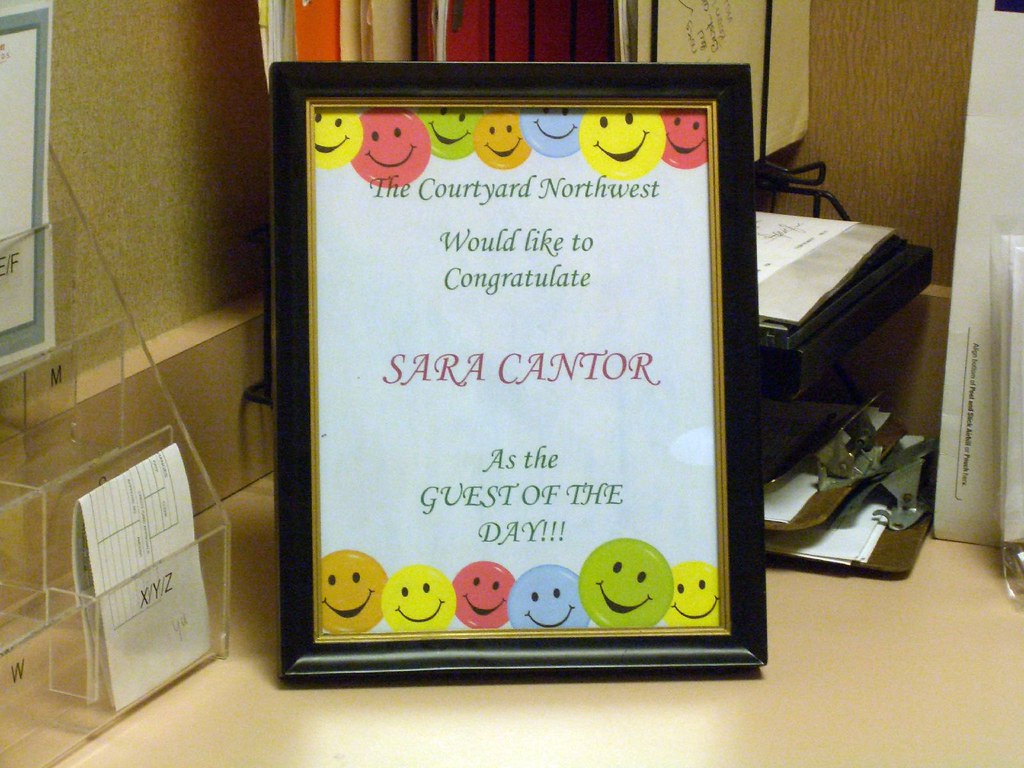
The incident faded as time passed. Then yesterday, I had another uneventful drive and routine check-in, this time at a Courtyard Marriott. Ho hum, another business trip. Here's my credit card and wait - what's that - is that MY name? - oh my god you guys, I'M THE GUEST OF THE DAY!!!


I literally jumped up and down. There it was, my full name on a framed piece of paper! What surprise, what delight. I felt like they knew me. I felt like a celebrity! I felt like Gary.

Of course, I immediately composed myself, in the manner of all contestants on Wheel of Fortune, preparing myself to be Shown What I've Won. I had a flash fantasy about a giant bubble bath with jets, about choosing my movie from a list of hot new releases. This trip was gonna be awesome.

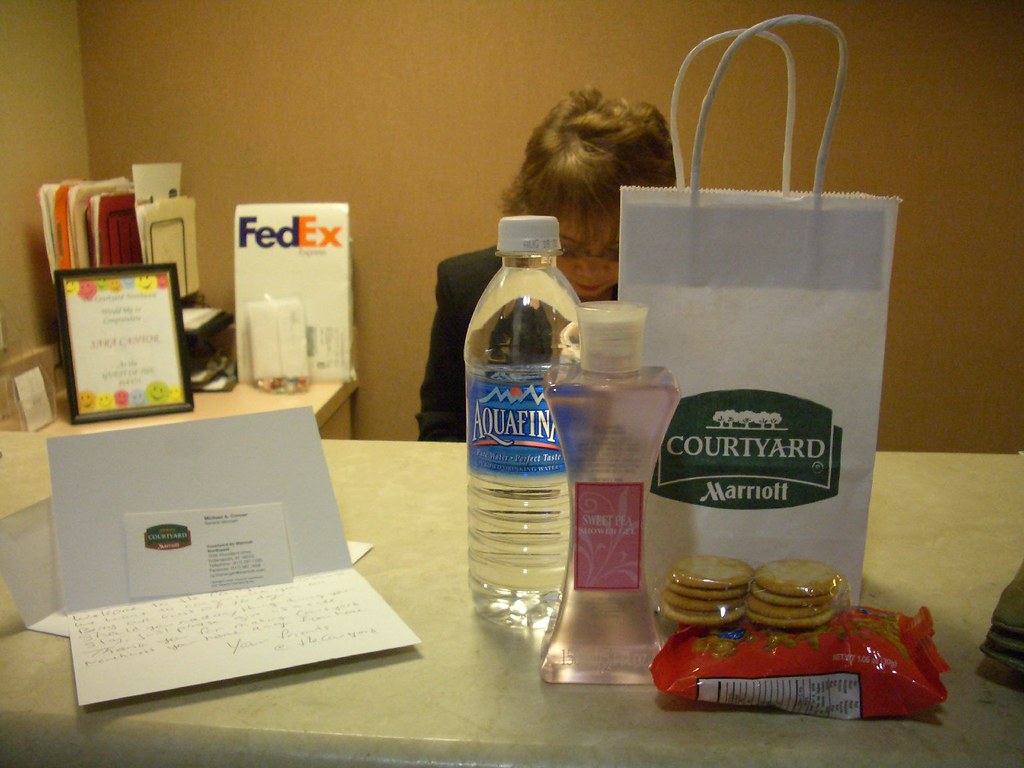
So the woman smiles and hands me a bag. A small bag. A small bag with the Courtyard logo. Okay. I reach inside. A bottle of water. A bottle of shower gel. A bag of animal crackers, and a packet of Ritz crackers. That's it. "That's it?" "Oh, and this," she says, and hands me an envelope. Ooh, an envelope! Surely, this is the big finish. It's definitely gonna be a gift card to a local restaurant, a coupon for a free massage, half off my next room at the Courtyard. I open it with high hopes.

It is far and away the most generic letter I've ever read. Fully devoid of meaning. "Welcome to the Courtyard. We want to congratulate you on being our Guest of the Day." Okay, thanks, now really, what do I get? "Should you need anything during your stay, just please give us a call." Okay, but I would do that anyway! Anyone would! We can all call the front desk, at any time! How am I different? "Thank you for making Courtyard your home away from home." Where is my prize? Show me the benefit!


As it turns out, there is no benefit to being Guest of the Day at the Courtyard Marriott. The water was room temp, the shower gel was cheap, and the animal crackers were stale. (I will admit that I enjoyed the Ritz crackers, but that is my only concession here). The single joy I experienced was seeing my name on a printout.

So here's the thing. If I hadn't stayed in the Holiday Inn a few weeks back, hadn't seen Gary's name and heard about his perks, I would have been delighted and only delighted to receive the minorly special treatment that I did. Wow, a bottle of water? Hey, it's better than my coworkers got! Ha ha to them! I'm the Guest of the Day! But since I had come face-to-face with the dry erase board on that fateful night, my bar had been raised. Significantly and irreversibly. And when this experience fell drastically below that bar, I was left feeling regretful that I ever walked through the Courtyard doors.

It's unfair to pit the two hotels against each other, but hey. That's the consumer world we live in. Somebody creates a nice experience for their customers, and everyone else rushes to catch up. It's nice for the Courtyard to try, and they get a big E for effort. But man. Shower gel? Animal crackers? I have never gone so quickly from surprise and delight, to disbelief and embarassment. What a letdown. I would have preferred to get nothing over a goody bag of crap.

So a part of me wishes they would only show my name. Seeing one's name is surprisingly thrilling, and I experienced a rush of somewhat childlike joy. It's like hearing your name on the radio when you donate to NPR. It's like seeing your birthdate in print. It's something familiar and personal, celebrated in public. The fact that every Holiday Inn Guest of the Day gets out his cellphone and takes a picture? A huge indicator of the significance. It's also quite funny, and makes for a good conversation piece the next day.

In fact, I believe if more retailers incorporated this simple "hold up a mirror" strategy, shoppers would feel a tinge of interest when walking in the door. They would always think, maybe it's me!

So an open letter to the Courtyard: The little poster is plenty exciting. It's all you need to make us feel welcome. If you can't deliver a better experience than the comparable establishment down the street, don't get our hopes up. Go for something that you can execute well, now. And stop right there.

8.22.2006

Was anyone helping you today?


So I walk into Banana Republic and start shopping. A guy comes up and asks if I need help. I do, in fact, need help. "Do they have these pants in black?" He goes to check.

It turns out they are out of stock, but he will be getting more in next week. The salesguy kindly writes down the store's phone number, and the pants' item number, so that I may call before coming. I found this to be exceedingly good customer service. He not only got me information, he held the promise of the pants I wanted. At this moment, he was my favorite salesperson ever.

But at this same moment, could I remember what he looked like?

Eh. Not really. He was oh, yea high, with brown hair, I think, and tannish skin. Yeah, he was definitely tan. Perhaps he was Indian? He might have been Indian. What if he wasn't Indian at all? I shouldn't say that, just in case I am wrong. What was he wearing? Did he say his name? How embarassing.

These thoughts ran through my head twenty minutes later, as the girl at the cashier asked me one very simple question: "Was anyone helping you today?"

---

I've noticed more and more clothing stores using this strange protocol. It basically helps assign commission to higher-performing employees. The theory is simple - if the customer says Kelly with the purple shirt was helping her, then Kelly with the purple shirt gets a little something added to her paycheck.

But what if you can't remember Kelly's name, or the color of her shirt? What if in your memory, Kelly's only identifying feature was that she was overweight? Good god.

To finish the episode, I continued to shop after the guy went away. The minute I picked up my second shirt, a nearby saleswoman asked if I'd like to start a dressing room. Fine, sure. A minute later, I picked up a skirt. "Do you want me to add that to your dressing room too?" I guess so, but you are starting to get on my nerves.

This woman added things to my dressing room. She "checked in on me." She was generally nice, but a bit intrusive. Sure, though, I suppose it was she who actually "sold" me the shirt, for no other reason than the fact that she was there before I decided to buy it, and she was there right afterwards.

So when the girl at checkout asked the question, I felt nothing but awkward. What I wanted to say was, "Well you see, two people helped me today, and the woman was technically the one to 'sell' me the shirt. But the guy helped me with a future purchase, while leaving a lasting positive impression of your store. Which the woman actually diminished. So I'd prefer to name him, but I guess I'll name both if I can. However, I can't remember what either of them looks like, I don't know their names, I can't see them from where I'm standing, and any attempt to describe them will only dig me deeper into this hole."

This response actually came out like, "Oh, uh, this lady..." I trailed off as I looked around. "Was it Kelly?" "Yes! I mean, I think so. Sure. Kelly."

I'm sure that this system works well from ten thousand feet away. Managers at corporate pore over the numbers and see that shoppers are responding, commission is being awarded, and associates are being incented to work a little harder. But when you are on the ground, standing at the desk, I believe that the system has some fundamental flaws.

First, the question implies that either someone helped, or no one helped. It's essentially a yes-or-no question. There is no gray area for qualitative feedback. I think stores should allow me to commend someone even though he or she didn't actually help me with the item I bought. What about the more general, "Did you experience good service today?" Or the more benefit-oriented, "Did anyone make your shopping trip easier?" Or the more frank, "Is there anyone you think we should pay more?" Hey - people appreciate a little honesty.

And this qualitative feedback should apply whether the response is good or bad. If someone made my shopping trip easier, but someone else made my shopping trip harder, why can't I say both? I know the cashier only has so much time when there are impatient customers behind me, but if you are taking down one name, you can take down two. If you are putting Kelly's name on the good list, you can just as easily put it on the bad list.

Second, the question forces shoppers to recall at least one awkward piece of physical information. Which is no doubt the last thing on their minds. I know that when I am in the midst of feeling distraught, because this shirt is too much money but I really love it, don't ask me to take note of someone else's personal details. They are just not that important right now.

And especially when we don't know which details are appropriate. My first identifier of the guy was his race, but that would be weird if it was right, weird if it was wrong. How about asking us to identify one specific, objective feature, like hair color? Or how about pointing to a poster of employee names and photos? (Even if you couldn't draw Kelly from memory, you could surely pick her out of a lineup). And what could Kelly do to help us remember? Wear a shirt with her name on it in large font? Escort us to the checkout? Hand us a plastic "business card" that we could give back when we pay? The shopper needs a little help here.

Finally, the whole incentive system leads employees to try to be memorable, not necessarily helpful. Because the real question ends up being, "Can you remember anyone in our store today?" That woman was erring on the side of annoying because she knew there was a chance I'd name her at the register. And you know what, I did. But if half your shoppers welcome assistance, and the other half just want to be left alone, you are going to strike out every other time. You personally might benefit from higher commissions, but your whole store suffers from the feeling of pushy staff.

So perhaps the goal shouldn't be to commend individuals, but rather the whole team. Maybe they are graded on specific attributes, so that the entire store may improve in certain areas. On a scale of 1 to 5, how friendly were our staff today? And tomorrow we ask, how helpful were our staff today? And the day after that we ask, how available were our staff today?

In a perfect world, all employees would be mind-readers, able to know in an instant whether a shopper wanted a helping hand or total avoidance. It's never going to happen quite like that. But if stores are looking for feedback on how their staff are really doing, they should think a little harder about the ways they gather it. Because when the answer isn't black and white, the question shouldn't be either.

8.02.2006

Bag, please


You might describe my boyfriend and I as environmentally conscious people. We don't work for Greenpeace or anything, but we saw An Inconvenient Truth and read Cradle to Cradle and subscribe to Dwell and make efforts to buy organic and conserve energy and recycle.

So you might expect this to translate to our shopping habits, and typically it does. When we each bought something at J.Crew last weekend, we asked that our purchases be put into one bag. Two bags is a waste. Sure, the salesgirl agreed, and put my stuff in his bag. Good for the environment, bad for the store.

Why is it bad for the store? Because shopping bags are a form of real-world advertising. You see a woman, presumably a well-dressed one, holding a J.Crew bag. Consciously or not, you ascribe her qualities to that brand. Wow, you think, J.Crew sure has attractive and fashionable customers. Maybe I should shop there too.

Stores want those bags out in the world, not tossed in a closet. This is why shopping bags have gotten more like purses and less like throwaways in the past few years. I've been handed bags lined with ribbon, coated with splashy paint, and made of materials far less recyclable than paper. The bag is now an extension of the brand, and with that title comes an obnoxious amount of waste. So whenever possible, I act like an informed consumer, and I skip the bag.

But sometimes, being an informed consumer isn't enough. We also visited Crate & Barrel last weekend. And what do C&B cashiers do with every item? They wrap it in tissue paper. Does that tissue paper save ceramic plates from cracking? I highly doubt it. But perhaps it gives the impression of safety. So fine, wrap each individual plate. Maybe it's helping people to think their new dishes won't break in the trunk of their SUV on the ride home.

However, we were buying dish towels. Just dish towels. Nothing fragile or heavy or expensive. Certainly dish towels don't need to be wrapped - if anything, they should be the wrapping! But it all happened so fast: the guy grabbed a big sheet of tissue paper, my boyfriend called out, "You don't need to - " and the guy cut him off with, "Too late!" He quickly finished the wrapping, gave a cheery smile and handed us the bag.

Shut down. We lost. We were no match for this man's sheer corporate obedience. He's been trained to wrap everything, presumably because of some "out-of-box experience" philosophy that everyone and their mother has borrowed from Apple. Perhaps Crate & Barrel imagines that when shoppers get home, they see their new dish towels, lovingly wrapped by the hands of the brand itself, and tied with a nice big bow of lifetime loyalty and positive word-of-mouth.

But does the wrapping make a difference to people? Do the bags make a difference to people? Because not to get all Doom And Gloom on you, but they are making a difference to our planet.

Now I don't think people are going to take a stand, exactly. You can raise awareness all you want, but you won't get shoppers to stomp their feet in defiance and say "If you wrap that placemat in tissue paper, god help me but I will never shop here again." Sure, we say, wrap it. Give me a big ornate bag filled with crinkly paper. It looks nice, implies some safety, and makes me feel special.

But frankly, people just take the bag because it's the default. They have their plates wrapped because it's the default. Americans will choose the default way more often than not; it's one less decision they have to make.

With that in mind, a good way to make change is to ask people to do nothing. Just engineer the environment around their inaction. So what if the default was no bag, no wrapping? The bag was readily available if they asked, but if they did nothing, they wouldn't get one? I think it would be a different world. Some people would take their dish towels as-is, and carry them out to the car. Or stick them in their backpack or purse. Many would ask for bags, but not all. Some would learn that they didn't really need a bag after all.

A final story: My mother used to buy our milk from a drive-thru shop called Farm Stores. She'd use the same line every time. "Gallon of skim milk, no bag." Every single time. We just didn't need a bag. It was one gallon of milk, and we were driving it straight home. She was an informed consumer, and didn't want to waste. However, because of this tiny extra effort, my mom was surely in the vast minority of customers.

Imagine if people had to say "Gallon of skim milk. Bag, please." I think we'd move the needle on packaging waste at retail.

4.25.2006

Member since yesterday

So there's this little thing that I've noticed a lot of retailers doing. They give their people dated nametags. Instead of just saying the person's name, they now say something like, "Team member since 2004."

Tamika at FedEx Kinko's was kind enough to let me take a picture of her nametag. But like Tamika, so many nametags I see say "Member since 2006." Last year, they all said 2005. Point being: when the person started this year, I think the nametag works against the store's favor.

Now maybe a new employee, upon receiving their "Member since 2006" nametag in April, thinks "Gosh, only 8 more months until I appear to have been here a year!" Maybe a new employee who arrives in December thinks "Sweet. I will have seniority so soon."

But whatever positive or negative effect this program has on morale, I don't suspect it's improved employee retention. Sure, all stores want their workers to commit. The costs to train new staff are high. But I doubt the nametags have improved motivation or loyalty - those issues run deeper than nametags.

So why else would a store make dated nametags? Maybe because, in theory, when someone's been there for a few years, we treat them with more respect. I mean, who doesn't love the old man with "Elmer. Member since 1962."

But from a shopper's perspective, we rarely run into Elmer at the local Jewel. And it looks really bad when every single employee is a member since 2006! It's like revealing their weaknesses! Putting "Untrained and inexperienced" signs on their backs! Putting "Nobody likes to work here" on their registers! Putting "This place is a revolving door" on their revolving doors!

Maybe if, instead of saying how long they've been here in years, they could say it in months. "Member since March 2005" is way more experienced than "Member since December 2005." Or they could make it future-facing: "My one-year anniversary is April 2007." Or they could tell us the employee's specialty in the store: "Tamika. Computers and printers." Or just something unique and human about them: "Tamika. My friends call me Mika." "Tamika. I'm also a volleyball instructor." "Tamika. Originally from Atlanta."

Retailers have tons of issues - hell, we all have tons of issues. But the issue of employee retention is, from what I hear, top of mind for some. These stores could start by finding ways to make their employees appear more human - through nametags, apparel, ways of showing off their strengths rather than their weaknesses. It takes a long time for a "Member since 2006" to feel important, and by that time, she's probably gone. Personalized gear could be the first step towards more human treatment from both shoppers and corporate. It could even become the tiny gesture that helps them decide not to quit.

3.20.2006

Mom parking

I saw this sign in the local CVS parking lot and thought, wow. That is so nice of them! What a kind gesture of customer empathy! It says "PARKING FOR EXPECTING MOMS AND CUSTOMERS WITH INFANTS." So they don't have to walk as far! It's right by the front door.

But then I had to wonder, if I were a mom, how might I feel about this? Perhaps I would be overjoyed. "Finally, someone recognizes all the struggles I'm going through with this giant belly/crying baby/crazy toddler."

Maybe. Or maybe I'd be a little pissed and get all women's lib about it. "God, here I am parking next to the handicapped people. Like being pregnant is some kind of disability. I'm perfectly capable of crossing the street, thank you very much."

Perhaps. But the worst part might be the massive gray area that this sign implies. What if I'm just barely pregnant? I'm not showing yet and my body hasn't changed? Will I get mean looks if I park here? What if my infants are at home, but they are still stressing me out? And hey, define infant! My son is 4 but he's still a spaz, does that count?

Even worse, what if someone 'outside of the demographic' parks there - what is the penalty for some dude just pulling up his truck? With handicapped spots, there are big badges on the rearview and clear fines if you break the rule. Nothing of the sort at CVS.

This sign is the latest incarnation of what we call the Honor Code. It's like those signs on the bus: "Please give up this seat to the elderly." You don't have to give it up, but you should. There even becomes social pressure if you don't. Or like those handicapped stalls in public bathrooms. I'll admit, I use them all the time. Never see any handicapped people waiting when I get out. But what if they were? I sure would feel bad.

Our society has already taken huge strides - for better or worse - towards preferential treatment of persons with disabilities. Advocates say they can better integrate; opponents say they are more marginalized than ever. But there it is - our wheelchair ramps and large bathrooms and handrails and parking spots are a part of America.

I guess I'm just wondering if the next group to receive special treatment is moms and expecting moms. And if so, I'm seeing the need for more clarity around the issue. Who's in, and who's out? Handicapped people get blue badges. Maybe moms could get a mom tag? Nothing embarassing, rather something to be proud of? Check me out, I'm either a) pregnant or b) raising a two-year-old? Cut me some slack because I deserve it?

Call me crazy, but if this is the direction our society is heading, then mom tags, positioned well, could be kinda cool. Maybe they'll have them by the time I'm a mom...