Woman enters store. Woman spots shirt. Woman checks sizes. Woman identifies shirt of her size. Woman takes shirt to dressing room. Woman finds shirt to be too large. Woman feels elated, then confused.
---
This scenario could happen to you. Perhaps it already has. This series of events is something that goes on periodically in the world of clothing retail, and it's a bit of a mixed blessing. It's called size inflation.
That's right, folks. You thought you were an 8? Guess again! Now you're a 6! Always been a medium? Now you're a small! Hooray, you say as you leave the dressing room to find the item in your new and improved size.
Now I won't name names, but I have experienced size inflation recently at a number of popular retailers. And I'll admit, when I bought my first skirt in a 6, I experienced tiny, temporary glee. Maybe I had lost weight? Or the yoga was paying off? And even though I hadn't changed a bit, and rationally I knew that, some deeply-buried emotional corner of my brain felt good. I would even venture to say that it influenced my purchase decision. "I like this skirt because it's a 6," a tiny voice said. So I can only imagine why stores shift their sizes. They are in hot pursuit of the magic moment when women realize, "Good god, I'm a smaller size!" That's right ladies, you too are a smaller size.
Except, of course, you're not. Your body is the same today as it was yesterday. Perhaps you've been a happy size 10 for years. You are accustomed to your size 10, and it makes shopping easier. So now, when you find that in some stores you are a 10, while in others you're an 8 and in still others a 6, well that's just confusing. With each new store, you have to bring at least two or three sizes into the dressing room. Your old standard is no longer standard.
So why would retailers put us through this trouble? Well, size inflation in clothing coincides neatly with size inflation at food establishments. It's right alongside the Super Size menus, the Big Gulps, the entrees at Cheesecake Factory. As meal portions grow, everything else grows too.
And so, not wanting to be "the only store where I'm still a 10," each retailer periodically updates its sizing structure so that women feel better about buying there. They keep up with the Gaps, if you will. And it tends to work out quite nicely - the women who have grown keep the same size, while the women who have not, go down.
But this is crazy! While other companies adjust according to reality, such as Tupperware making larger lunch containers or airlines adding wider seats, clothing stores are simply shifting these arbitrary numbers called sizes! While it's clever from a psychological perspective, it's also denying reality. It's changing the macro so we don't feel the micro. It's keeping that woman from noticing her own changes.
---
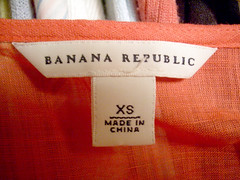
I recently purchased my first-ever extra small top from Banana Republic. I may be on the thin side, but still. There is no way I am an extra small in this world. I didn't feel any joy this time - just annoyance. After trying both a medium and a small, I felt strange when I finally took the extra small and it fit. "If I am an extra small," I thought, "what size does Jessica wear?" (My little sister is far more narrow than me). And who is wearing the mediums that I used to buy? The whole experience was slightly disconcerting.
Depending on which way you look at it, they've made the clothes bigger, or the sizes smaller. It's like currency inflation, and I get it. You follow the trends, and you make adjustments. But I wish there was another way. Because this practice affects women in a fundamental manner. You are messing with our perceptions of ourselves, and prolonging our inevitable facing of facts. It feels artificial because it is artificial.
I think retailers should get together and slow the size inflation cycle. Just add numbers on at the top. Integrate more of the plus sizes into the main lines. It would be a pretty inclusive strategy, and as long as everybody was in agreement, nobody would get hurt. Maybe this is unrealistic, but it's not impossible. Surely retailers would prefer not to go through costly resizings every few years!
People make a big deal over the fact that Marilyn Monroe wore a size 12. Oh, how our standards for beauty have changed, we say. But was she told that her dress was a 4, to make her feel better? I doubt it. There's a reason some members of the industry call this practice "vanity sizing" - we are more vain than ever, and more ready to equate thinness with beauty. Size inflation is just one part of this unhealthy cycle. I'd love to see it end.


11 comments:
I'd personally love to see woman's clothing go to a measurement system that actually has some vague connection with the real world. If my husband is shopping online someplace, he can put in his waist size, and it will fit. If I'm shopping, I must go, grab a measuring tape, look up some buried size chart, compare, try to figure out which size I should get when I inevitably fall between two, and give up and don't buy it. I would love to walk into a store and see a pair of pants advertised as a "36 waist, 40 hips" instead of "size 6, relaxed fit". Give me measures that mean something, and are consistant from store to store!
I see your point and am intrigued by your connection to growing portion sizes. So, by using "vanity sizing" stores are essentially helping women ignore the fact that they are gaining weight or are overweight. On top of that, if a woman once bought 8's and then found a 6 that fit, don't you think she'd be less likely to change anything that was currently unhealthy in her diet? I mean, if her current eating got her from an 8 to a 6, she must be doing something right...
seriously what size would i have to get? like a xxxs? DON'T think they make that one. haha.
How about this scenario:
Man enters store, says hello to cute salesgirl
Man sees clothes he would like and approaches the rack
Man looks at items on rack
Man picks out item he wants and checks size
Instead of men's sizes, labels read 8/10/12
Man realises with horror that he has been looking at women's clothes
Attempt to pass off incident without blushing fails
Salesgirl laughs at man's buffoonery
Man flees store, never to return
This incident may or may not have happened to me in the recent past. So you see, for men, the problem is much less complex. Getting to the right part of the store and trying on something that isn't a blouse is rated a success. BTW, love your work Sara
Mazlynn, I am totally with you on this one. Why not use actual sizes, in worldwide standards such as inches or millimeters? Women's sizing is both arbitrary and inconsistent, while men's is straightforward and regular. Perhaps women are seen as more easily manipulated, but I'd like to prove otherwise.
Yes Jessica, you are tiny. I hope your size doesn't fall off the map.
Robin, perhaps we should talk about your desire to wear women's clothing. We can take that conversation offline if it's less awkward for you. :)
You're so right about this. I once bought a size 4 skirt at Limited Express and felt really good about it even though I knew I had not lost weight. Here in Italy, I'm a honking size 42 and in dress shirts, a LARGE even though I'm objectively the same size as before. I realize this is ridiculous but I have to say, I shop less.
It's also becoming increasingly difficult for those of us who actually are small to find stores that carry reasonably-priced clothing that actually fits us outside of major metropolitan areas! And the children's section just doesn't cut it -- most of that isn't fitted for adult curves, and practically none of the styles in the girls section are suitable to wear to work! (Can you tell that I'm becoming quite frustrated here?)
Just today, while hunting for a new button-down shirt to replace the ones in my wardrobe that are starting to wear-out, I encountered a shirt with a tag that said "Small" but which was actually LARGER than the shirt I was wearing, the tag of which reads "Medium"!
This size inflation is ridiculous and it has got to stop! Just tell the fat people that they're fat already!
I struggled over the last few years to loss the 25bls I gained in college. Believe me, when you are 5ft tall, 25bls is a lot: I was in an unhealthy weight class. So, I’m finally back to a healthy weight for a 5ft person only to go into the stores and find out I fell off the edge of the fashion earth. The stores stole my victory be sizing me out while I was away. X-small is huge in every store at the mall! I look like a child in here moms closet! I’m almost 30! So I’m shopping in the juniors stores and still going online to buy special small sizes. These stores are losing my business because they are sizing out me and small framed women like me. I heard banana republic was thinking of making a 000 size for small women. This spring seems even worse: I’m so sick of it.
The Europeans size more or less by hip size. A standard US size 6 is more or less a 36 in European sizes. In Old Sears Catalogues dresses and blouses were measured by bust sizes from 32"-44"/46". For most women, bust and hip measurements are within 2" of one another. I have a 26" waist and 36" hips and I recently bought a pair of ladies work pants in a size 2 (and that was the smallest size they carried). Women's stores as opposed to girls's stores are even more guilty of size inflation. Most 40 and 50 something women don't have hip measurements under 36" but clothing lines like to start their sizes at a 2. However, I am seeing inflation creeping into girls clothing. My sister, who is the same size as I am just bought an XS dress. We're both 5'7 and 140 lbs -- definitely not small
The real issue comes when you fall off the bottom edge. At 5'7" and 125lbs, I've now gone from the 6 I always was to finding some 0's that fall off me. Now that is problem enough, but I'm still usually able to find something in between the 0-2 sizes. My poor mother, however, at 5'5" and 100lbs, fell off the bottom long ago. 0's are too big for the poor woman. As a fairly fashionable woman, this is very difficult for her. And really, at age 51, resorting to the Juniors section is no longer a valid option.
Remember when the overweight women of the world fought for plus sized sections? I say it's time for the normal sized women of the world to band together and protest before we all fall off the bottom!
Size inflation is such a mixed blessing... I just blogged about it too! http://adventuresinbizcasual.blogspot.com/2011/11/if-everyones-size-4.html
Post a Comment